Paper heart, p.1
Paper Heart, page 1


Also by Cat Patrick
Tornado Brain
Just Like Fate, with Suzanne Young
The Originals
Revived
Forgotten
G. P. Putnam’s Sons
An imprint of Penguin Random House LLC, New York
Copyright © 2021 by Cat Patrick
Excerpt from Tornado Brain copyright © 2020 by Cat Patrick
Penguin supports copyright. Copyright fuels creativity, encourages diverse voices, promotes free speech, and creates a vibrant culture. Thank you for buying an authorized edition of this book and for complying with copyright laws by not reproducing, scanning, or distributing any part of it in any form without permission. You are supporting writers and allowing Penguin to continue to publish books for every reader.
G. P. Putnam’s Sons is a registered trademark of Penguin Random House LLC.
Visit us online at penguinrandomhouse.com
Library of Congress Cataloging-in-Publication Data
Names: Patrick, Cat, author.
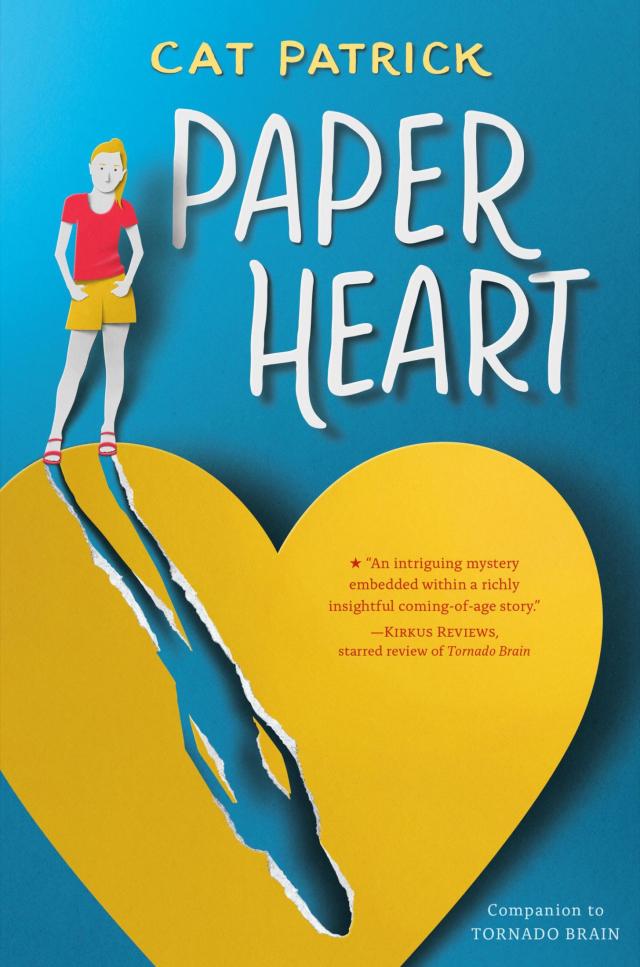
Title: Paper heart / Cat Patrick.
Description: New York: G. P. Putnam’s Sons, [2021] | Summary: Companion to: Tornado brain.
Identifiers: LCCN 2020058377 (print) | LCCN 2020058378 (ebook) | ISBN 9781984815347 (hardcover) | ISBN 9781984815354 (ebook)
Subjects: CYAC: Grief—Fiction. | Anxiety—Fiction. | Friendship—Fiction. | Art—Fiction. | Day camps—Fiction. | Camps—Fiction. | Family life—Fiction.
Classification: LCC PZ7.P2746 Pap 2021 (print) | LCC PZ7.P2746 (ebook) | DDC [Fic]—dc23
LC record available at https://lccn.loc.gov/2020058377
LC ebook record available at https://lccn.loc.gov/2020058378
Ebook ISBN 9781984815354
Jacket art by Eiko Ojala | Jacket design by Eileen Savage
This book is a work of fiction. Any references to historical events, real people, or real places are used fictitiously. Other names, characters, places, and events are products of the author’s imagination, and any resemblance to actual events or places or persons, living or dead, is entirely coincidental.
pid_prh_5.7.0_c0_r0
For my elf,
the one who lifts everyone else.
I’ve got you.
♥ ♥ ♥
contents
Cover
Also by Cat Patrick
Title Page
Copyright
Dedication
Prologue
Chapter 1
Chapter 2
Chapter 3
Chapter 4
Chapter 5
Chapter 6
Chapter 7
Chapter 8
Chapter 9
Chapter 10
Chapter 11
Chapter 12
Chapter 13
Chapter 14
Chapter 15
Chapter 16
Chapter 17
Chapter 18
Chapter 19
Chapter 20
Chapter 21
Chapter 22
Chapter 23
Chapter 24
Chapter 25
Chapter 26
Epilogue
Excerpt from Tornado Brain
Acknowledgments
About the Author
prologue
“Shhh!” Frankie hissed in the darkness, which only made me and Colette giggle harder. “You guys are so annoying!”
In the furniture-packed bunk room, Frankie was on one of the top bunks; our cousin Kennedy was sleeping like a starfish on the full-size bed, her covers rumpled on the floor; and Colette and I shared the queen-size bed.
Colette and I had been telling ghost stories—quietly, I’d thought.
“Frankie, lower your voice,” I whispered. “You’re going to wake up Kennedy. That would be zero percent amazing.”
“Whatever,” Frankie said, still too loudly. She was sometimes not great at matching her volume to the situation. “You guys are zero percent amazing! You’re making it impossible to sleep!” In the moonlight through the window, I saw her throw her arm over her eyes. “And the crickets are so loud! They’re driving me crazy! I hate it here. I just want to go home. Wyoming sucks!”
She sounded like she was going to cry.
“We’re sorry,” I whispered, immediately feeling bad. She’d had a hard time falling asleep as it was. I sat up and inchwormed toward the bottom of the bed since I was on the side next to the wall. “Here, we’ll go downstairs so you can sleep.”
Kennedy rolled over with a sleep-groan. The rest of us held still like we’d been freeze-tagged until she got settled again.
I turned back to tell Colette, “Come on,” but she was already out of the bed, ducking into her sweatshirt. A best friend to both me and Frankie since kindergarten, Colette knew how to disarm my twin sister almost as well as I did.
“Want my noise-canceling headphones?” she whispered to Frankie, resting her arms on the frame of the bunk. “They’ll drown out the stupid crickets, at least.”
Frankie thought about it, then said, quieter, “Fine.”
“Sorry for keeping you up,” I whispered, hovering in the doorway while Colette dug her headphones out of her bag. I chewed on my right pinkie nail. “Did you take your vitamin?”
“Uh-huh,” Frankie said even quieter, taking the headphones and putting them on. She closed her eyes and didn’t say anything else.
Colette turned and gave me a thumbs-up. Carefully, I crept down from the loft, steps creaking behind me as Colette followed. I held tight to the right handrail nailed to the stacked log wall but had nothing to grip on the left: no handrail or wall, either. If I lost my balance and tipped left, I’d fall into the living room.
Apparently, when my great-grandfather built this cabin with his brother way back in the olden days, safety wasn’t a big concern. My mom likes to say, “It’s hardly up to code,” whatever that means. All I know is that I was putting my life in my hands every time I took those stairs.
Thankfully, we made it to the bottom. Colette and I tiptoed across the main common space, knowing one of five adults—Mom, Charles, Aunt Maureen, Uncle Bran, or Grandpa—could appear from the darkened hallway at any moment and tell us to go back to bed. Worse, we could wake up Kennedy’s preschooler brother, Kane, and he’d cry, and then we’d really be in for it.
Relief washed over me when my flip-flop hit the gravel driveway outside.
“Here,” I said, grabbing the bug spray from the back-porch step and aiming it at my friend. “Otherwise, the horseflies will eat us for a late-night snack.”
I shivered, thinking of the angry welts on my legs, then doused Colette in the terrible-smelling spray.
“Use a lot,” I said, handing her the can.
Coughing through the cloud, we made our way toward the field next to the cabin. We got settled on the boulder big enough for two, both of us hugging our bare knees since it’d gotten cold after the sun went down, staring up at the biggest sky I’d ever seen. It wasn’t just above but all around us, a pitch-black background dotted with billions of stars. I felt like I was in a night-sky snow globe.
“I’m really glad my parents let me come with you guys,” Colette said. “Pinedale is the coolest.”
“I don’t know about the coolest.” I laughed, talking easily with Colette. She was probably the only person I talked that easily with. “Cities that have art galleries and restaurants and stuff are cool. I’d like to go to New York someday. Or Washington, DC. This town only has like four hundred more people than ours.”
I meant our home of Long Beach, Washington. In a way, because no big companies had messed with either and they’re both pretty far from major cities, Pinedale and Long Beach are similar. But Pinedale’s more “Wild West” and surrounded by mountains and lakes, while Long Beach has more of a beach vibe since it’s on the Pacific Ocean.
“Frankie told you the population, didn’t she?”
“Natch,” I said with a laugh. Frankie loves facts.
I looked around at the nothingness and listened to the crickets and breathed the sagebrush and felt calmed by it all. “Yeah, I guess it’s pretty great here.”
“It’s too bad Frankie doesn’t think so.”
“I know.” I swatted away a hovering horsefly, thinking of the epic meltdown Frankie had had the night before, first about having to sleep in the same space as three other people and then about the spider near her bed. Frankie has ADD and is on the autism spectrum, and sometimes things that seem fine to me are massively unfine to her. Then again, even when things were more normal, I worried about dying daily—and Frankie once walked toward a tornado—so I guess she’s stronger than me in a lot of ways.
“That internet quiz said I definitely have anxiety.”
“You needed an internet quiz to tell you that?” Colette said, nudging me with her shoulder. I shrugged. “I don’t get why you don’t just ask your mom to get you a therapist. I mean, she sends Frankie to one.”
“That’s why,” I said. “Therapists are expensive. She can’t afford to send both of us.”
“She said that?”
“No, but she would.”
I wasn’t really sure what she’d say. The truth was that I felt like, if I was really so bad off, my mom would’ve worried about me in the same way she’d worried about my sister. She would’ve forced me to go to a therapist already. Instead, she usually just told me to stop biting my nails or worrying so much if I ever brought anything up. She didn’t really understand what was going on in my head, and I didn’t really want to tell her, because my sister was . . . a lot.
“Anyway, keep going,” I said.
Before Frankie had gotten mad, Colette had been telling a ghost story about Crybaby Bridge, some bridge on the East Coast that was rumored to be where a monster threw crying babies who were annoying him over the railing.
Colette did an excited shoulder dance.
“Okay, so! Tons of people commented on the person’s post and said that if you go, you can sometimes, very faintly, hear the babies crying!”
“Ohmygod,” I said, shaking my head. “That’s so terrifying.”
“I know, but guess what!”
“What?”
“It’s actually goats!”
“Crying ghosts? That’s worse.”
“No, goats,” Colette said.
“The monster throws goats?” I asked.
“Ohmygod, Tess.” Colette threw her head back and laughed really hard. “No, the cries aren’t babies, they’re goats! I guess goats sound like crying babies. So, people were getting all freaked out, but it was just goats roaming around, eating grass under the bridge.”
“No way!” I said, laughing, too. “I love goats.”
“Me too,” she said. “Once, at a petting zoo, a goat ate a hole in my T-shirt.”
“I’ve seen them mow an entire field,” I said. “They need to mow this!” I waved my hand around in front of us, hitting another horsefly in the dark. They were lurking outside the perimeter of our repellent, waiting to chomp.
Colette shifted on the rock, leaning to one side and then the other to pull her shorts down. “Okay, your turn!”
“Okay,” I said, taking a breath, ready to share the story I’d been writing in my mind for weeks. In a low, quiet voice, I said, “Once there was young man named William who fell madly in love with the butcher’s daughter, Lilah.”
“Did you say the butcher’s daughter?” Colette said, scooting closer. “That’s never good.” She gasped. “Look! A falling star!”
“Where?” I asked, searching the sky until I saw the diagonal two-inch streak, brighter on the low end and fading at the top, then disappearing altogether.
“Make a wish.”
We both closed our eyes and made wishes but didn’t tell each other what they were because then they wouldn’t come true.
Colette said, “Keep going.”
“Okay, so William and Lilah went out on many romantic dates—”
“What did they do?” Colette interrupted.
I tilted my head to the side and looked at her with an annoyed expression.
“What? I like romantic details.”
I laughed, then said, “They went on picnics and to the movies and walks on the beach and stuff, I don’t know. Anyway, Lilah fell madly in love with William, too. They talked about going to Paris someday because that was Lilah’s dream, to go to chef school in Paris. So, William proposed, and Lilah accepted, and they got married six months later.”
“Way to rush into it.”
“Shhh,” I said, laughing again, feeling her own laughter in my rib cage. We were so squished together we were like one being. “They took over the butcher shop from Lilah’s dad and had a great life. For William’s birthday one year, Lilah knitted him a beautiful red scarf to keep him warm all the t—”
“Ew, red is ugly,” Colette interrupted. “He needs a yellow scarf. Yellow is way happier.”
“No men wear yellow scarves.”
“I know, he’ll be unique!”
“What shade of yellow?” I asked, my art brain taking over.
“I don’t know . . . bright?” Colette asked back, laughing.
I sighed. “Fine, she knitted him a bright yellow scarf. He loved it so much he wore it everywhere. But one day, he came home without it, and he told Lilah that he didn’t remember where he’d left it. A few weeks later, a beautiful woman rang the doorbell. She was like modelworthy.”
“I think I know where this is going. Pumpkin Eater City.”
“Totally. So, she says, ‘Your husband left this at my house.’ Lilah didn’t ask any questions; she just slammed the door on the woman and went to confront William, who was working at the butcher shop. She was convinced he was cheating on her!”
“Billy’s in trouble.”
“His name’s William.”
“He goes by Billy to his friends.”
“He totally doesn’t,” I said. “And this is my story. Shush your face.”
Colette clamped her palm over her mouth, smiling at me with her sparkling eyes. “Go on,” she said in a muffled voice.
“No one knows what happened with William and Lilah,” I said, “but after that day, Lilah was never to be seen again. And William turned really weird, like he’d just walk around and stare at people blankly, all spaced-out and stuff. He’d barely talk to customers and his skin looked bad and he was just . . . strange.”
“He was heartbroken,” Colette mumbled behind her hand.
“But he still wore his yellow scarf everywhere, even in the summer when it was really hot like it was earlier. The scarf got all smelly and dingy, and people would try to get him to take it off because—gross—and he’d scream at them to get away from him. They all assumed he wore it as a reminder of the long-lost love of his life.”
Colette shivered next to me.
“Decades later, William died.”
“Of what?”
“I don’t know, natural causes. So anyway, Lilah and the beautiful woman who’d brought back the scarf that day were both at his funeral. Lilah had returned to the town for the first time in forever to get closure or whatever. She was mad that the woman was there, too, and that she was still beautiful even though she was older.
“Even in the casket, William had on the gross old scarf with his suit. He’d put in his will that he wanted to be buried in it. After the funeral, the women ended up being the last people in the church. They stood next to William’s casket. Lilah said, ‘After all these years, I need to know why. Why did he have an affair with you? I thought he loved me! I thought we were so happy!’ The other woman gasped and said, ‘Oh my goodness! That’s what you think? That’s not what happened at all! Your tenth anniversary was coming up. William was going to surprise you with a trip to Paris. I’m a language teacher; I was teaching him French!’”
“No way!” Colette said, moving her hand to grip my sweatshirt. “This is insane!”
I giggled, happy that she was into it.
“Then what?” she asked excitedly.
“Then the beautiful woman left Lilah alone in the church with William. Lilah cried over William’s body and said she was sorry. Then she left. Since everyone was gone, the priest came back in. He’d been outside giving them space. It was a cold winter day, and he’d seen a homeless person shivering on the steps. He looked at William’s body and considered whether he should give the homeless person William’s scarf. The priest figured that the casket would be closed before William would be buried, so the family wouldn’t know. William was gone, so he wouldn’t know. And the homeless person wouldn’t be so cold, and that was good. The priest decided to take the scarf.”
“Ew, don’t touch dead William and his dirty scarf!” Colette said quietly. She was gripping my arm so tightly, my hand was starting to fall asleep.
“Well, I think he regretted it, because when the priest removed William’s scarf, he realized why William had worn it all those years.”
“Why?” Colette asked in a small voice, her eyes huge in the darkness.
“Without the scarf holding it on, William’s head fell off.”
“GIRLS!” someone snapped harshly.
Colette and I jumped. I don’t know who screamed first, but I know I stopped last. Dogs started barking somewhere, and as if that wasn’t enough, I heard Kennedy’s brother, Kane, start to cry from inside the cabin.
My mom stood under the back porch light with her hands on her hips. “It’s after midnight!” she scolded. “Come inside right now!”