

From the abyss, p.1
From the Abyss, page 1


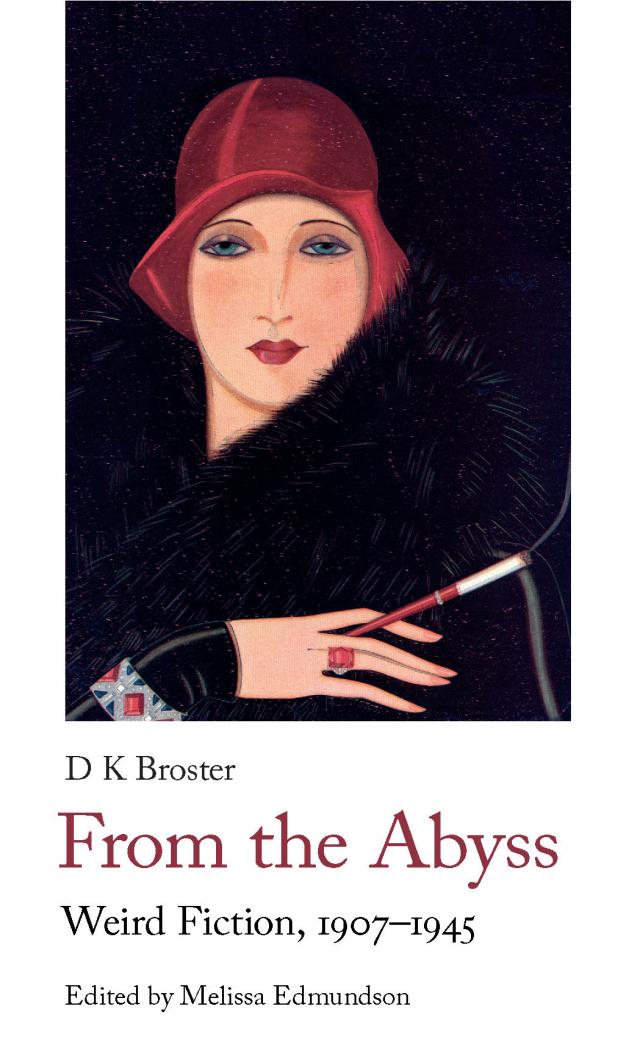
From the Abyss
Other Handheld Classics
Ernest Bramah, What Might Have Been. The Story of a Social War (1907)
John Buchan, The Runagates Club (1928)
John Buchan, The Gap in the Curtain (1932)
Melissa Edmundson (ed.), Women’s Weird. Strange Stories by Women, 1890–1940
Melissa Edmundson (ed.), Women’s Weird 2. More Strange Stories by Women, 1891–1937
Zelda Fitzgerald, Save Me The Waltz (1932)
Marjorie Grant, Latchkey Ladies (1921)
Inez Holden, Blitz Writing. Night Shift & It Was Different At The Time (1941 & 1943)
Inez Holden, There’s No Story There. Wartime Writing, 1944–1945
Margaret Kennedy, Where Stands A Wingèd Sentry (1941)
Rose Macaulay, Non-Combatants and Others. Writings Against War, 1916–1945
Rose Macaulay, Personal Pleasures. Essays on Enjoying Life (1935) Rose Macaulay, Potterism. A Tragi-Farcical Tract (1920)
Rose Macaulay, What Not. A Prophetic Comedy (1918)
James Machin (ed.) British Weird. Selected Short Fiction, 1893–1937
Vonda N McIntyre, The Exile Waiting (1975)
Elinor Mordaunt, The Villa and The Vortex. Supernatural Stories, 1916–1924
Malcolm Saville, Jane’s Country Year (1946)
Helen de Guerry Simpson, The Outcast and The Rite. Stories of Landscape and Fear, 1925–1938
Jane Oliver and Ann Stafford, Business as Usual (1933)
J Slauerhoff, Adrift in the Middle Kingdom, translated by David McKay (1934) Elizabeth von Arnim, The Caravaners (1909)
Sylvia Townsend Warner, Kingdoms of Elfin (1977)
Sylvia Townsend Warner, Of Cats and Elfins. Short Tales and Fantasies (1927–1976)
This edition published in 2022 by Handheld Press 72 Warminster Road, Bath BA2 6RU, United Kingdom. www.handheldpress.co.uk Copyright of the Introduction © Melissa Edmundson 2022. Copyright of the Notes © Kate Macdonald 2022.
All rights reserved. No part of this publication may be reproduced, stored in or introduced into a retrieval system, or transmitted, in any form, or by any means (electronic, mechanical, photocopying, recording or otherwise) without the prior written permission of the publisher.
The moral rights of the authors have been asserted.
ISBN 978-1-912766-57-4
1 2 3 4 5 6 7 8 9 0
Series design by Nadja Guggi and typeset in Adobe Caslon Pro and Open Sans.
ebook Conversion by Bluewave Publishing
Contents
Acknowledgements
Introduction
Bibliographical details
1 All Souls’ Day (1907)
2 Fils D’Émigré (1913)
3 The Window (1929)
4 Clairvoyance (1932)
5 The Promised Land (1932)
6 The Pestering (1932)
7 Couching at the Door (1933)
8 Juggernaut (1935)
9 The Pavement (1938)
10 From the Abyss (1940)
11 The Taste of Pomegranates (c. 1945)
Notes on the stories By KATE MACDONALD
Acknowledgements
My thanks to Kate Macdonald of Handheld Press, for commissioning me to curate the stories in this book.
I would also like to express my gratitude to Oliver Mahony, the Archivist at St Hilda’s College, University of Oxford, for providing copies of D K Broster’s typescript of ‘The Taste of Pomegranates’, as well as for graciously allowing permission to reprint the story in this present volume.
I also wish to thank Jeff Makala for his feedback on the introduction and for his editorial assistance.
And my gratitude, as always, goes to Murray, Maggie, Kitsey, and Simone for their furry support.
Melissa Edmundson is Senior Lecturer in British Literature and Women’s Writing at Clemson University, South Carolina, and specializes in nineteenth and early twentieth-century British women writers, with a particular interest in women’s supernatural fiction. She is the editor of a critical edition of Alice Perrin’s East of Suez (1901), published in 2011, and author of Women’s Ghost Literature in Nineteenth-Century Britain (2013) and Women’s Colonial Gothic Writing, 1850–1930: Haunted Empire (2018). She also edited Avenging Angels: Ghost Stories by Victorian Women Writers (2018).
She has edited these Handheld Press titles: Women’s Weird: Strange Stories by Women, 1890–1940 (2019), Women’s Weird 2: More Strange Stories by Women, 1891–1937 (2020), Elinor Mordaunt’s The Villa and The Vortex: Supernatural Stories, 1916–1924 (2021), and Helen de Guerry Simpson’s The Outcast and The Rite: Stories of Landscape and Fear, 1925–1938 (2022).
Introduction
By Melissa Edmunson
If the name ‘D K Broster’ is familiar to contemporary readers, it is most likely due to a popular trilogy of historical novels she published in the 1920s. These books, known as the ‘Jacobite Trilogy’, are the bestselling The Flight of the Heron (1925), The Gleam in the North (1927), and The Dark Mile (1929). Throughout her decades- long career as a professional writer, from the early 1920s until a few years before her death in 1950, Broster enjoyed critical and commercial success as a novelist, with most of her novels published by William Heinemann. The normally reclusive Broster, who tended to avoid the public spotlight (see Spear 2012), made headlines when she attended London parties hosted by Heinemann and visited areas of Scotland made famous in her fiction.
Broster’s contributions to short fiction, and especially weird short fiction, received less attention during her career and those who have read her novels might be surprised to discover this facet of her writing career. Broster’s short fiction represents an even broader span of her writing career, with stories appearing during the first decade of the twentieth century until the 1940s. Many of these stories are similar in theme and setting to her novels and are centred on historical characters and events from the eighteenth and nineteenth centuries. yet Broster also published weird and supernatural tales in several major magazines of the day, including Macmillan’s, Chambers’s, the Cornhill, and Good Housekeeping. Several of these stories later appeared in her two collections of stories, A Fire of Driftwood (1932) and Couching at the Door (1942). These weird stories represent only a small portion of her output as a writer, but they reveal a very different side to the author. : Weird Fiction, 1907–1945 highlights this other side to Broster’s career – and perhaps the more shadowy undercurrents of her own psyche as well. The stories in this volume are wonderfully varied and include incidents of pure horror, subtle psychological studies of obsession, haunted houses, and tales of ghostly doubles. These stories reveal a true mistress of the form, one who could craft a deceptively quiet narrative where fear is just around the corner, lying in wait to catch us off guard.
Dorothy Kathleen Broster was born on 2 September 1877 at Grassendale Park, Garston, in Liverpool. She was the eldest of four children born to Thomas Mawdsley Broster, a shipowner, and Emily, née Gething. Broster received a private education until she was ten years old, and then attended a boarding school in Lancashire. After the family’s move to Cheltenham when she was sixteen, Broster became a day student at Cheltenham Ladies’ College. At nineteen, she was awarded a scholarship to St Hilda’s College, Oxford. While an undergraduate, she was secretary of the St Hilda’s College Debating Society and contributed to The Fritillary, a magazine of the Oxford women’s colleges, which she edited from 1898 to 1899. Broster excelled at her university studies, and in 1900 she achieved a second-class honours degree in modern history. yet because women students were not at that time permitted to be awarded their degrees, she had to wait until 1920 to receive her BA and MA. On 15 October 1920, the Times reported on the historic ceremony, listing Broster (as well as Dorothy L Sayers, who graduated from Somerville College) among the first 29 women to receive an Oxford degree (Anon 1920, 7).
After completing her studies Broster spent thirteen years working as the secretary to Sir Charles Harding Firth, Regius Professor of Modern History at Oxford. During this time, Broster also began publishing poetry and fiction. Her first historical novel, Chantemerle (1911), was co-authored with Gertrude Winifred Taylor. This was followed by The Vision Splendid (1913), once again co- written with Taylor.
During the First World War, Broster, who spoke fluent French, volunteered as a nurse. In late 1914, she was working in Belgium and by 1915 was working with the British Red Cross and stationed at an Anglo-American hospital in yvetot, France. However she was forced to return to England at the beginning of 1916 after suffering from a leg infection.
Broster’s post-war novels showcase her continuing interest in history, with most being set in the eighteenth and early nineteenth centuries. These include Sir Isumbras at the Ford (1918), The Yellow Poppy (1920), and The Wounded Name (1922). A 1923 visit to Lochaber in the Scottish Highlands inspired Broster to write her Jacobite Trilogy. Their publication marked the beginning of a long professional partnership with William Heinemann as well as a lifelong interest in Scotland and its history. During her fifth visit to Scotland in 1928, a newspaper article about her visit opened with, ‘The Highlander or even the Lowlander of Scotland who has not read The Flight of the Heron and The Gleam in the North must, I am sure, be one of a small minority.’ The Jacobite Trilogy made Broster a household name in the country, as the writer declared, ‘D K Broster is for most of us a name t o conjure with, for she has made the ’45 Rising and the years of its aftermath into a living story of our own people’ (Anon 1928). Her Jacobite novels remained in wide circulation in Scotland well into the 1990s.
Broster continued to publish historical novels throughout the 1930s and 1940s. Many have naval settings, possibly influenced by her father being a shipowner, which in turn led to Broster’s continuing love for the sea. These include Ships in the Bay! (1931), The Sea Without a Haven (1941), and The Captain’s Lady (1947). In August 1924, shortly after the publication of her novel Mr Rowl, the Bookman ran a brief feature on Broster’s work accompanied by a rare published photograph of the author. The piece highlights her ability to lend psychological complexity to her characters within the context of a historical novel, which, according to the writer, tend to be ‘costume novels’ with little character development (Anon 1924, 267).
D K Broster was, by all accounts, a private person and rarely gave interviews or appeared at public functions. One exception was an interview with Jean Boyd which appeared in the 1 July 1928 issue of the Scottish weekly paper The Sunday Post, fittingly titled ‘Who Is This D.K. Broster?’ In this, she discussed her writing practices and the amount of work that went into researching and writing her historical novels. She claimed to be a perfectionist when it came to historical accuracy, saying,
It is certainly no easy job writing historical novels. you cannot let your characters gallop off on their own as they always seem to want to do. The movements of all the troops have to be historically correct, yet I don’t suppose half of my readers realise that when they read my books. And I don’t suppose they care a damn whether they are correct or not. It would worry me, however, if they were not. (Boyd 1928, 17)
This attention to detail meant that Broster typically spent years on a book before it was ready for publication. She said, ‘I work regularly and hard, but it takes me at least two years to finish a book, because I put a great deal of hard study and research into everything I write’ (Boyd 1928, 17).
Other biographical details about Broster’s life remain sparse. She lived for many years with her close friend and companion, Gertrude Schlich, in Catsfield, Battle, in Sussex. Schlich was the daughter of Sir William Schlich, a professor of forestry at Oxford. Broster dedicated her novel The Yellow Poppy to Schlich in 1920. Broster and Schlich also collaborated on the mystery novel World Under Snow, published by Heinemann in 1935, which is credited to Broster and ‘G Forester’ (Adrian 2001a, xxiv).
There are occasional mentions of both women in local news- papers. In 1937, the Hastings and St Leonard’s Observer reported that Broster gave a talk at the local literary society on the seventeenth- century priest Father Gilbert Blackhall (Anon 1937b). In May 1937 and April 1939, Broster and Schlich were recognized for their gifts to Buchanan Hospital, located in St Leonards-on-Sea (Anon 1937a; Anon 1939). Broster died on 7 February 1950 at Bexhill Hospital. In 1957, Schlich endowed a scholarship at St Hilda’s College in Broster’s name.
D K Broster collected her weird and supernatural fiction in A Fire of Driftwood (1932) and Couching at the Door (1942). A Fire of Driftwood is divided into two sections, with the first section dedicated to historical tales. The second section contains a few stories centering on supernatural events, including ‘All Souls’ Day’, ‘Clairvoyance’, and ‘The Window’. Other stories in this section verge on dark or macabre narratives with no supernatural content. These include ‘The Book of Hours’, ‘Fate the Eavesdropper’, and ‘The Promised Land.’ Another story, ‘The Crib’, features a nativity come to life and verges on parable. The stories in Couching at the Door, with the exception of ‘The Pavement’, a dark tale of obsession, are all supernatural in some way. In addition to the title story, this collection includes ‘The Pestering’, ‘’, and ‘Juggernaut’. These stories were published from 1907, when ‘All Souls’ Day’ appeared in the September issue of Macmillan’s, up until the publication of ‘’ in Chambers’s Journal in December 1940, suggesting that Broster had a continuing interest in the weird and supernatural modes. The fact that she was a bestselling novelist during these decades and financially secure also implies that the stories were not written purely for money.
Reviews for both A Fire of Driftwood and Couching at the Door were generally positive. In an April 1932 review of Driftwood, the Bookman singled out ‘The Promised Land’ as ‘by far the best in the whole book,’ calling it ‘pure Tchekov [sic]’ and a story that ‘could not have been better written’ (Anon 1932). H C Harwood, writing in the Saturday Review, preferred the stories in the second half of the book, noting that these showcased Broster’s gift for writing such narratives: ‘In Miss Broster’s short stories there is, however, a lot of kick. I refer more particularly to ‘Clairvoyance’ and ‘The Promised Land’, either of which should have established the author as a really first-rate horrifier, a petticoated Poe. […] The sadly fantastic is what she does best’ (Harwood 1932, 349). Cecil Roberts, in his review for the Sphere, likewise noted the ‘extraordinary Poe-like gruesomeness’ of ‘The Window’ (1932, 418).
In its review of Couching at the Door, the Scotsman noted that the stories were a departure of sorts from her usual historical themes, but nonetheless declared that she had ‘certainly achieved success’. The reviewer also appreciated the range of the stories contained in the book, from the ‘definitely supernatural’ to the ‘borderland of mystery which, while stopping short of the supernatural, serves as a reminder of how much of strangeness human life may contain’ (Anon 1942). Vernon Fane, writing for the Sphere, recommended the collection and drew attention to ‘Couching at the Door’ and ‘The Pavement’ for coming closest to what is called the ‘authentic effect’ of good ghost stories, that is, ‘the slight prickling of the scalp and the rather self-conscious nonchalance of that look round the room to make sure one’s quite alone’ (Fane 1942).
Though both collections are now out of print and first editions are increasingly difficult to find, Broster’s supernatural writing has enjoyed more sustained recognition than that of several of her contemporaries. Interest in her weird fiction began almost immediately after the publication of Couching at the Door. Peggy Wells’s adaptation of ‘The Pestering’ was broadcast on BBC Home Service Radio as a 4.15 afternoon matinee on 12 December 1945 (Anon 1945). In her Times obituary, Broster’s historical novels take priority, but the obituary ends with a mention of this facet of her career: ‘History apart, Miss Broster had an imaginative predilection for the supernatural and the occult’ (Anon 1950). Of all the stories, ‘Couching at the Door’ is the most frequently anthologized. Shortly after appearing in the Cornhill, Dorothy L Sayers included it in Great Short Stories of Detection, Mystery and Horror (3rd Series, 1934). It was later included in Philip Van Doren Stern’s The Midnight Reader (1942) and again in Stern’s Great Ghost Stories (1962). Alfred Hitchcock selected it for two anthologies: Bar the Doors! Terror Stories (1946) and Stories They Wouldn’t Let Me Do on TV (1957). The darker elements of the story led John Keir Cross to include it in Best Black Magic Stories (1960). ‘Couching at the Door’ gained more recognition after it was collected in The Penguin Book of Horror Stories (1984), edited by J A Cuddon. Broster’s supernatural and weird fiction were collected in two more recent books that are now out of print. These include Couching at the Door, edited by Jack Adrian and published by Ash-Tree Press in 2001 as a limited hardcover edition of 600 copies. In 2007, Wordsworth Editions published another collection, also called Couching at the Door, as part of their ‘Tales of Mystery and the Supernatural’ series.
Jack Adrian has discussed Broster’s gift for the macabre, noting the lack of redemption and depiction of graphic violence that is such a departure from the themes and concerns of her longer fiction. For Adrian, this mysterious dichotomy has unexplainable (and therefore tantalizing) possible connections to Broster’s personal life:
She is, in every way, the master of her craft, writing of a distinctly uncomfortable world in which ugly things appear without warning, and sudden, shocking, and (what’s far worse) entirely arbitrary psychic violence occurs. And why Dorothy felt the need to create such stories is just one more vexing question to do with a life that teems with vexing questions. (Adrian 2001a, xxx)






