Canopy, p.1
Canopy, page 1


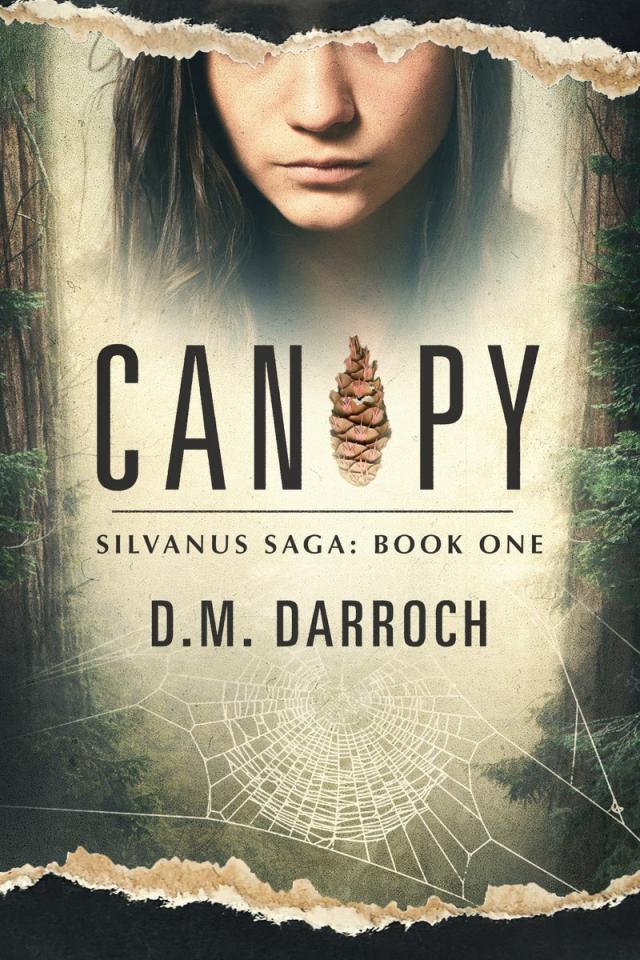
Canopy
Silvanus Saga Book 1
D. M. Darroch
ISBN 978-1-890797-21-8
Copyright © 2021 by D.M. Darroch
* * *
www.DMDarroch.com
This is a work of fiction. Names, characters, places, and incidents either are the product of the author’s imagination or are used fictitiously. Any resemblance to actual persons, living or dead, events, or locales is entirely coincidental.
Published in the United States by Sleepy Cat Press. No part of this publication may be reproduced, stored in a retrieval system, or transmitted, in any form, or by any means, electronic, mechanical, photocopying, recording or otherwise, except for brief quotations in printed reviews, without written permission of the publisher.
This book is sold subject to the condition that it shall not, by way of trade or otherwise, be lent, resold, hired out, or otherwise circulated without the author’s prior consent in any form of binding or cover other than that in which it is published and without a similar condition being imposed on the subsequent purchaser.
Requests to publish work from this book should be sent to: danelle@dmdarroch.com
Books by D.M. Darroch
Inventor-in-Training series
The Pirate’s Booty
The Crystal Lair
Cyborgia
* * *
For young children
No, No, Nora
For Carol Ann
Contents
The Present
From The Book
Chapter 1
Chapter 2
Chapter 3
Chapter 4
Chapter 5
Chapter 6
Chapter 7
Chapter 8
Chapter 9
Chapter 10
Chapter 11
Chapter 12
Chapter 13
Chapter 14
Chapter 15
Chapter 16
From The Book
Chapter 17
Chapter 18
Chapter 19
Chapter 20
Chapter 21
Chapter 22
Chapter 23
Chapter 24
Chapter 25
Chapter 26
Chapter 27
Chapter 28
Chapter 29
From The Book
Chapter 30
Chapter 31
Chapter 32
Chapter 33
Chapter 34
Chapter 35
Chapter 36
Chapter 37
Chapter 38
Chapter 39
Chapter 40
Chapter 41
The Present
Acknowledgments
The Present
Spiders and their webs don’t scare me. Actually, I quite like them. We have a lot in common: we’re both silent and alert, largely solitary, stealthy and agile. Many species of spider devour their mates and others are known for their stinging bites; most are gentle if left alone. But the thing that really connects me and spiders is that even though we’re both good for the community—they keep the insect population in check and I heal people—everyone loathes us.
The climbing boots in my hands are heavy, and I’m not entirely sure what I’m meant to do with the strings dripping out of them. The bottom of the boot is encased in thick metal spikes, brown with rust. I drag a stick across a spike and scrape away the brown to reveal a dull gray. These spikes will penetrate the Great One’s hide. Will they stab deep enough to injure the tree? Will the tree be in pain? Will the tree bleed? Does a murderer worry about the pain of another? Even if that other is a Great One?
The Book of Silvanus commands that shoes never be worn, that the skin of a climber’s foot always commune with the skin of the Great Ones—and I’m eager to try them on. I sink one naked foot, stained brown from years of running on pathways and climbing trees, a stain that washing fades but never removes entirely, into the depths of the boot. The hard shell imprisoning my foot is alien and slightly painful, pressing against my ankle bone, heavy on my toes.
I wasn’t always The Blight. I once had friends, more or less. I once had a family. Those that have survived I’ll never see again. Not in this lifetime.
The canopy hasn’t felt like home for a long time. My childhood died with Joshua. I barely noticed when Yew left. My anger served to protect me from not fitting in, being set apart, feeling the resentment of the other climbers. I no longer need the anger; I’m not sure it ever helped. And I don’t know what will help me where I’m going, but I’m fairly certain anger will be useless.
I was taught the climbers need us, we the special ones, the blessed ones, the healers, the descendants of Pseudotsuga, leader of the First Climbers. This mythology is passed from one generation to the next along with the expectation of cool reserve, scientific detachment, and above all, a perfection unattainable for the average human being.
Despite what my enemies think, I’m as average as they come. That is, if average means convicted of offending the Great Ones, dishonoring The Book of Silvanus, and breaking the commandments.
Most climbers never knew me, not really, and now they never will. It turns out I didn’t know them all that well, either. But then, how well can we really know someone else’s heart? Especially when we can’t even understand our own.
The branch drifts in the wind and here I sit, my past and my future separated by an unimaginable climb.
From The Book
Once in the canopy, we discovered a vast world of flora and fauna unknown to humans. Upon discovering that huckleberry bushes, hazelnut trees, and salmon berries self-seeded and thrived in the nooks and crannies of the huge trees, we experimented with the seeds of other plants.
We learned to practice horticulture, planting vining crops, small fruit trees, and shade-loving vegetables among the leaf litter and needle detritus collected in the limbs and cracks of the mammoth trees. We planted herbs for every ailment: headaches, stomach aches, menstrual pains, arthritis. We planted herbs for recreation, relaxation, attention, and altered states: stimulants, depressants, psychedelics. And then we began to build.
Boughs of eight to ten feet across supported rough shelters and platforms. We linked the gargantuan limbs of the genetically engineered trees with hanging bridges constructed of cedar ropes and bark slats. We learned how high we could climb until the limbs no longer supported our weight.
We learned to hunt arboreal mammals, raccoons and opossums and all varieties of western squirrel, first with pistols, and when we ran out of bullets, by crafting short bows from the nurse-log maples. We began to raise and train Cooper’s hawks and sharp-shinned hawks to hunt small mammals in the trees and on land. We learned how to weave cedar strips by hand to make strong ropes. We crocheted hammocks and carved bowls and rain barrels. We experimented with plant fibers, hand sewing clothing with needles we fashioned from bird bones.
When we determined we had all we needed to live, we resolved never to set foot on the ground again. We resolved to live and die in the trees, far removed from the impending climate apocalypse, future resource wars, and pandemics threatening the earth far below us.
Pseudotsuga, The Book of Silvanus
Chapter One
The afternoon light streamed through the branches above me, becoming brighter as I approached the sky. I’d climbed to the twelfth bough, far above the legal limit, and crossed into the Outer Reaches hand over hand, sweat flowing, adrenaline pumping, feeling every hair on my arms, legs, and scalp extend into the air as if to catch the breeze and float me between the trees like an orb weaver. But unlike those eight-legged creatures, I had no proteinaceous silk to catch me if I fell. No rope, no net, nothing but the roots far, far beneath the Great Ones, the giant Douglas firs that we lived among. Boughs and branches and twigs could compound my fractures, breaking fingers, arms, and thigh bones. They’d impale me, gut my torso, and break my head. Precisely this threat of danger, the adrenaline rush of tempting a painful death, pushed me onward.
Life had ended too soon for many others: frail kids sickened and died; elders withered; some of our parents even fed the Great Ones. Those were the unlucky others. Not me. I was smart and agile. I knew how far I could push myself, and I rarely did anything stupid. The few times I’d gotten hurt, I healed quickly.
I sat leaning against an outer trunk, dangling my legs from the too-thin, weak branch, my heart in my throat as the wood creaked, bending beneath my weight. I repositioned my gangly self—I do physically resemble a spider in many respects—and hung from my legs, reaching out with my arms to feel for a stronger limb. I swung back and forth, gathering speed, then whooped and released, dropping down to a lower limb. The adrenaline buzzed through my brain, and I was breathless and happy.
I was the first one to arrive at our hangout spot, so I found an area where the needles grew thickly and concealed myself. To know the truth about anyone else, you must eavesdrop. Imagine all the secrets a spider hears from the dark corners between the branches.
I’m not saying everyone is a liar, but most people don’t tell the truth. Some, like my poor excuse for a father, lie to save their sorry selves, but most people conceal things from you because they think you’re too young, or they don’t want to hurt your feelings. Maybe they themselves don’t know the whole truth. Early on, I learned that the only one you can trust is yourself.
Wingnut wasn’t coming to the Outer Reaches. He’d told us earlier that morning, but none of us ever expected him to join us. We always invited him, but he never came. Sorbus teased him about not coming along. He accused Wingnut of staying behind to flirt with the women of Bough Six. If I didn’t know better, I might have thought Sorbus was jealous. Wingnut was tall, handsome, strong, and had charisma for days. He often entertained young women in his shanty on Bough Seven. I knew more about Wingnut’s sexual encounters than I cared to—Salix made certain of that.
According to Salix, all of the Bough Six women were crazy for Wingnut. And as quickly as the name of Wingnut’s current lover changed, so too did the person that Salix and her friends shunned.
On the branch beneath me, I heard a loud grunt followed by laughter and some jocular cursing, and I knew that Mangrove and Sorbus had arrived. I repositioned myself and peered through the limbs over their heads. They were jostling each other roughly. Of course, like idiots, they weren’t wearing climbing ropes. I wasn’t wearing climbing ropes either, but I wasn’t wrestling anyone on top of a twelfth bough, and frankly I was a much better climber than either of them.
Mangrove and Sorbus had been best friends since childhood, but they couldn’t have been more different. Mangrove was wiry and quick. His curly light brown hair framed his sand-colored face like a pruned shrub, spirals of hair tightening as it grew. The springiness of his hair matched the tautness of his body. I wondered whether his limbs relaxed when he slept; I couldn’t imagine what that looked like in him. He was constantly in motion, his brown eyes darting side to side beneath his thick brows, missing nothing. He leaned his back against a tree trunk, bounced a leg nervously, and picked fir needles from his curly hair.
Sorbus was short, dark, and stump-like. He lay face up on the branch, balanced on his spine, and stretched his muscular ebony arms and legs off each side. Black hair covered his arms like a pelt. Although in his teens like the rest of us, Sorbus already had a beard thicker than most men twice his age. His long black curls had locked together as his hair grew, and he wore the thick tangles pulled into a sloppy ponytail. The long, thick mass of hair pillowed his head on the branch.
“Hey, losers! Give me a hand up. This limb I’m standing on is groaning like it’s about to break!” yelled a female voice below them.
“That’s cuz you eat too much, fat ass.” Sorbus rolled to his stomach and reached his massive arms down to haul up Salix. Slightly smaller and much less hairy than her brother, Salix was also short, dark, and solid. That was where their similarities ended.
“No more than you, tubby.” She fluffed her halo of dark curls. Her eyes flickered toward Mangrove, who studiously ignored her. “Where’s your sweetheart? Your squeeze?” She gasped, threw her head back, and uttered several suggestive, high-pitched sighs. “Your heart’s true desire?”
“Shut up, Salix.”
“Stood you up, did she?” Salix plopped down on the limb beside Sorbus and picked at a hangnail. “It’s that rancid odor of desperation you give off. Keeps the girls away.”
“Sorbus, can you do something about this? She is your sister, after all.”
“Just because we shared a womb doesn’t mean I have any control over her.”
“Born two seconds before you. Means I’m the boss, possum-breath.”
Sorbus swung his arms and legs off the limb again. “Ignore her. Eventually she’ll go away. Like a fly.”
“More like a mosquito. She’ll bite us full of holes before she leaves.”
“Aw, come on you guys. You know you love me. Who else is gonna tell you the truth? But seriously. Where is Ostrya? I haven’t seen her all day.”
Mangrove shrugged and looked away. Salix rolled her eyes and turned her attention to her brother. “How did your meeting go, Sorbus? Did you get the traineeship with Cedrus?”
“Yeah.”
“That’s great!” She punched his arm. “So, give me the details. What did he say? I mean, you certainly weren’t his first choice.”
“Thanks for the vote of confidence.” Sorbus rubbed his arm.
“Come on, don’t be like that. Tell me what happened! I need details.”
“Four of us applied. Canopy needs builders, so they took all of us.”
“Yeah, but how’d you get Cedrus? I’m sure the other three wanted to work with him. He’s the best. Everyone knows that.” Salix was a know-it-all. Even when she had no clue.
“Salix, geesh. Do you really think I suck that hard? That he wouldn’t choose me?”
Salix pressed her brother. “Just tell me. How’d you get it?”
Sorbus rolled his eyes. “Cedrus chose last.”
Salix whooped. “I KNEW it! You only got Cedrus because he had no other choice!”
“Mangrove, do you know how lucky you are NOT to have a sister?”
“I thank the Great Ones.”
I’d been on the receiving end of Salix’s needling many times myself. If she weren’t my only female friend, well, I wouldn’t have any. It was time to make my entrance, so I pretended I’d just arrived. “Hey! Are you guys down there?” I called.
“Hey there, Ostrya! Get on down here!” yelled Salix.
I swung out of the tree to Salix’s far side. Mangrove stepped beneath me; his arms extended upward as if I needed help. Really insulting when you consider I could climb circles around him.
“You gonna move?” I shimmied down the tree trunk, my thighs clenched tightly to its girth and my fingernails digging into the bark.
“I thought … an extra hand …,” he said.
I snorted, kicked his arms away, and jumped down to the branch. I dusted off my thighs and blew my loose, tangled hair out of my eyes.
Mangrove’s eyes roamed from my legs to my stomach, and then upward. When his eyes finally reached my face and I met them with a clear look of my own, he reddened, which of course set me off into a blush. I turned my head to find a seat and moved over next to Salix.
“So, how’s everyone?” I asked brightly, hoping Salix didn’t mention my burning cheeks. I had no desire to be her next victim.
“Yeah, so my dumb brother got chosen by Cedrus.”
“Hey! That’s great news, Sorbus,” I said.
His eyes flickered over to me, and a hint of smile touched his lips.
“He was the only one left. Cedrus had no other options.”
I shot her a look, but she ignored me. We both knew that when it came to treating brothers kindly, I had little to say. But Sorbus had talked about this traineeship for the past year. “Cedrus is lucky to have you,” I said.
“Want to know about my traineeship?” asked Mangrove, staring at me.
“Sure, tell us,” said Salix.
“I’ll be answering to Maestro Hamamalis.”
“Maestro Hamamalis heads up the agriculture crew. I didn’t know you wanted to garden.” Salix expressed the surprise I also felt.
“No, I won’t be a gardener. I’m going to be a hunter.”
“Do you need a traineeship for that? I mean, grab a spider stick and whack away.”
Sorbus sneered. “Duh, Salix. When was the last time you ate a spider? Where do you think the meat at the market comes from? A team of hunters supplies the meat for all us climbers. Hunters are the only ones allowed to kill prey.”
“Well, technically we’re the only ones allowed to take more than we need, because we provide for others,” said Mangrove. “Any of you could kill to protect yourselves, like from a spider. And you could hunt to feed your family, but only your family.”