Kill your brother, p.1
Kill Your Brother, page 1


Praise for Kill Your Brother
‘Kill Your Brother brings Jack Heath’s unique sense of twisted fun home to Australia for what could be his best thriller yet. It’s brilliant from start to finish, boasting an irresistible premise and shocking twists all the way through. It’s fiendish in its cleverness and startling in its originality. Don’t miss it.’
GABRIEL BERGMOSER, author of The Hunted
‘Forget the plot twist, Jack Heath’s books are pure twist from start to finish.’
SARAH BAILEY, author of The Housemate
‘Jack Heath’s latest thriller is like Survivor on steroids . . . but with real intelligence and a ton of heart. Kill Your Brother is rural noir at its hottest, grittiest and most claustrophobic . . . and its most exciting.’
GREG WOODLAND, author of The Night Whistler
‘Keep Kill Your Brother with your passport and children, because if the house catches fire, you’ll fight to take it with you.’
PAUL CLEAVE, author of The Cleaner
‘Jack Heath’s new novel, Kill Your Brother, is compelling from its chilling title to the gripping finish. Evil flies out from where you least expect.’
JOHN M. GREEN, author of Nowhere Man
‘Kill Your Brother is a pacy, tense thriller with memorable characters and an unpredictable mystery at its core. I gulped the entire thing down in a single sitting and you’ll want to do the same!’
SAM HAWKE, author of City of Lies
‘A complex and claustrophobic thriller with a hell of a conundrum at its core, and a truly twisted series of developments along the way.’
ALAN BAXTER, author of Bound
‘Heath’s characters grab you by the throat and drag you with them—every fight, every defeat, every hope.’
SULARI GENTILL, author of Shanghai Secrets
This is a work of fiction. Names, characters, places and incidents are products of the author’s imagination or are used fictitiously. Any resemblance to actual events, locales or persons, living or dead, is entirely coincidental.
First published in 2021
Copyright © Jack Heath 2021
All rights reserved. No part of this book may be reproduced or transmitted in any form or by any means, electronic or mechanical, including photocopying, recording or by any information storage and retrieval system, without prior permission in writing from the publisher. The Australian Copyright Act 1968 (the Act) allows a maximum of one chapter or 10 per cent of this book, whichever is the greater, to be photocopied by any educational institution for its educational purposes provided that the educational institution (or body that administers it) has given a remuneration notice to the Copyright Agency (Australia) under the Act.
Allen & Unwin
83 Alexander Street
Crows Nest NSW 2065
Australia
Phone:(61 2) 8425 0100
Email:info@allenandunwin.com
Web:www.allenandunwin.com
ISBN 978 1 76106 539 2
eISBN 978 1 76106 314 5
Set by Midland Typesetters, Australia
Cover design: Luke Causby/Blue Cork
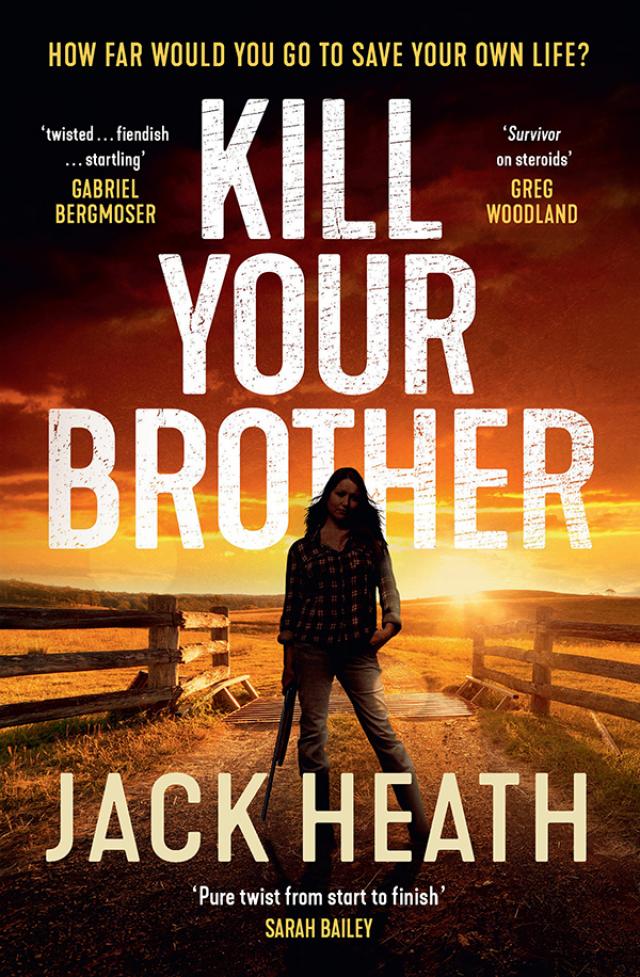
Front cover photos: Colin Hawkins/Getty (woman); Quirex/Getty (farm gate)
For my brother, Tom
CONTENTS
AUTHOR’S NOTE
PROLOGUE
CHAPTER 1
CHAPTER 2
CHAPTER 3
CHAPTER 4
CHAPTER 5
CHAPTER 6
CHAPTER 7
CHAPTER 8
CHAPTER 9
CHAPTER 10
CHAPTER 11
CHAPTER 12
CHAPTER 13
CHAPTER 14
CHAPTER 15
CHAPTER 16
CHAPTER 17
CHAPTER 18
CHAPTER 19
CHAPTER 20
CHAPTER 21
CHAPTER 22
CHAPTER 23
CHAPTER 24
CHAPTER 25
CHAPTER 26
CHAPTER 27
CHAPTER 28
CHAPTER 29
CHAPTER 30
CHAPTER 31
CHAPTER 32
CHAPTER 33
CHAPTER 34
CHAPTER 35
CHAPTER 36
CHAPTER 37
CHAPTER 38
CHAPTER 39
CHAPTER 40
CHAPTER 41
CHAPTER 42
CHAPTER 43
CHAPTER 44
CHAPTER 45
CHAPTER 46
CHAPTER 47
CHAPTER 48
CHAPTER 49
CHAPTER 50
CHAPTER 51
CHAPTER 52
ACKNOWLEDGEMENTS
ABOUT THE AUTHOR
AUTHOR’S NOTE
This book is based on the Audible Original Kill Your Brother. It has been expanded and revised for print and digital publication. Both versions of the story contain scenes that some readers may find disturbing. The book is unsuitable for children and some adults.
If somebody whispered to me, ‘You can have your pick’, If kind fortune came to woo me, when the gold was thick, I would still, by hill and hollow, round the world away, Stirring deeds of contest follow, till I’m bent and grey.
—Grantland Rice
PROLOGUE
‘I think we got off on the wrong foot,’ the woman says.
Elise keeps her voice even. ‘Right.’
‘Are you hungry?’ The woman’s hair is steely grey, her arms muscled from years of labour, her right shoulder bruised from the butt of a rifle. But she sounds gentle, like someone’s aunt. The illusion is completed by a sleeveless linen shirt with mother-of-pearl buttons, and the plate of homemade biscuits she’s put on the antique coffee table.
‘I’m fine,’ Elise says.
The woman slides the plate towards her anyway. The biscuits are topped with raspberry jam and sprinkled with coconut, but their sweetness might be hiding a more dangerous ingredient. Elise grips the arms of the recliner, her fingertips gouging the overstuffed fabric, so she won’t be tempted to take one.
‘You poor thing.’ The woman is looking at the puncture wounds on Elise’s hands.
‘They don’t hurt,’ she lies.
‘Here.’ The woman crosses the living room and opens a lacquered pine cupboard.
Her back is turned. Should Elise run? But she’s still weak from the tranquilliser—and it’s already too late. The woman is coming back, taking Betadine and bandages from a plastic box.
‘Really, I’m okay.’ Elise needs antibiotics, not antiseptic. The woman ignores her, kneeling and dabbing the stinging fluid on the scratches, then winding stretchy bandages around her knuckles and wrists.
The woman’s fingers are cold, talon-like. Elise can smell Lady Grey tea on her breath.
Soon Elise’s knuckles are trussed up. She looks like a kickboxer about to step into the ring.
‘There. All better?’ The woman sounds as though she’s talking to a toddler.
Elise nods.
‘I don’t want you to be uncomfortable,’ the woman presses. ‘No more than is necessary.’
‘Thanks.’
The woman puts the first-aid box back in the cupboard and settles into the couch opposite. ‘So,’ she says, ‘we have a problem. I hope we can solve it together.’
Elise doesn’t trust herself to speak.
The woman continues: ‘There’s an American term: beef. It means to take issue with something someone has done. Or something someone else has done—a “beef” can be inherited. You’ve heard of that?’
‘I guess so,’ Elise says cautiously. It’s almost funny. She’s on a sheep farm, but the sheep are long gone, and the farmer is explaining the concept of having a beef.
‘Have we met before?’ the woman asks suddenly, frowning.
Elise’s pulse goes into overdrive. ‘I, uh, saw you following me. I wouldn’t say we met.’
‘But before that?’
‘No, I don’t think so.’
The woman gives Elise a thoughtful look. Elise has dyed her hair red and cut it short, and there’s a phoenix tattoo on her neck—has she changed enough?
Finally the woman leans back against the couch. ‘Hmm. Just a moment of déjà vu.’
Elise holds her gaze. ‘Must be.’
‘Anyway, I have no problem with you. My beef is with him.’ The woman jerks her head towards the back of the house.
‘What did he do to you?’ Elise tries to sound as though she doesn’t care one way or the other.
‘To me? Nothing at all.’ The woman clears her throat. ‘The point is, I can’t let you go. Because you know he’s here.’
Elise licks her lips. ‘I won’t tell anyone about—’
‘Don’t insult me,’ the woman snaps. For a second, the friendly aunt disappears, replaced by something hard and sharp. Her deep-set eyes darken in her leathery face. Then the warmth is back. ‘So I find myself in a pickle—that’s a good expression, too.’
A grandfather clock ticks softly in the corner.
‘When I captured him, I made sure no one would come looking, or I thought I had.’ The woman gives Elise a grudging nod. ‘But I made no such preparations with you. People must be wondering where you are.’
Elise doubts this. She’s unemployed. She has no friends left. Anyone who notices her disappearance will be pleased about it. No help is coming.
‘I think I have a solution.’ The woman stands up again. There’s a little cardboard box on the mantel. The woman opens it, and produces a knife.
Elise tries to leap out of the armchair. The woman lunges at the same moment. Elise makes it only halfway up before the woman shoves her back down and pins her against the upholstery, crushing her shoulder. She’s terrifyingly strong. Elise has no hope of overpowering her. Not with the sedative still swimming through her veins.
The knife trembles in the woman’s grip. It’s a short blade, just big enough to slice an apple. Through clenched teeth, she says, ‘Hear me out.’
Elise swallows, her heart thumping in her ears. ‘Okay. I’m listening.’
The woman releases her. Puts the knife on the coffee table next to the biscuits, raises her open palms. ‘Here’s my proposal. I’ll let you go. And you won’t tell the police where you’ve been.’
‘Deal,’ Elise says quickly.
‘I’m not finished.’ The woman picks up a biscuit. ‘You won’t tell anyone—because if you do, you’ll be arrested for murder.’
Sickly dread fills up Elise’s guts. ‘Murder?’
‘That’s right. I promise I’ll set you free.’ The woman takes a bite, chews, swallows, and brushes some coconut off her lip. ‘All you have to do,’ she says, ‘is kill him.’
CHAPTER 1
The studio looks like a mechanic’s office—white-painted brick, an unmarked metal door, murky stains on the driveway. It’s tucked between a takeaway shop and a tile display showroom in the industrial outskirts of Canberra. Given the prices Aiden Deere charges for his paintings, Elise had expected something a bit fancier. A fountain, maybe. A sign, at least.
Despite the wintry morning breeze, she unzips her puffer jacket. Tugs her tank top down. She’s not above showing some cleavage, if that’s what it takes. She breathes in and out, rehearsing the line in her head. Raps her knuckles against the door. Waits.
No one comes.
After a minute, Elise’s composure slips. He hasn’t even opened the door yet, and already things aren’t going to plan. She’s screwed up somehow, like always.
She knocks again, louder. When she presses her ear to the door, she hears the whirring of an extractor fan.
There’s a small window to the right. Darkness inside. Elise makes binoculars out of her hands and presses them against the dirty glass. The studio is cavernous, with stacks of wooden frames in one corner and cans of paint in another. A huge orange canvas is veined with abstract smears of white and yellow. On a battered desk, a laptop is glowing.
Elise looks around. The only visible car is a white Holden Barina, parked forty or fifty metres away. A popular model: the third one she’s seen today. The driver is facing the feed store on the other side of the street.
Satisfied that she’s not being observed, Elise feels her way around the window frame. The hinges are visible, so it must open outwards. But there’s nothing to grab. No way to pull it. She rummages in her bag for something she can use to lever it open.
Something moves behind the glass, and she stifles a yelp. Someone has been standing in front of the canvas this whole time, camouflaged by his paint-splattered overalls. A straight razor drips in one gloved hand. Goggles and an air filter cover his face. He’s looking right at her.
Heart pounding, Elise knocks on the glass, like she wasn’t trying to break in. The man seems to get bigger as he approaches. The studio floor is elevated above the ground, but even so, he’s at least two metres tall and as wide as a removalist or a wrestler.
He fiddles with a hidden latch, then pushes the window open a crack. ‘Yes?’
‘No one answered the door,’ Elise says.
‘I’m working.’ The man gestures at his canvas with the razor, flicking some paint off the blade.
Elise is no art critic. In high school, her visual arts teacher gently asked her if she was colour blind—twice. But to her, the painting doesn’t look great. Just smudges in various shades of orange. Maybe it’s not going well. Maybe that’s why the painter looks pissed off.
‘Can I come in?’ she asks, waiting to see if he recognises her from the news.
‘Who are you?’
She exhales, relieved. ‘My name’s Tina Thatcher—I’m a private investigator.’ The lie sounds natural. The two-hour drive from Warrigal gave her plenty of time to practise.
She opens her wallet. An image search showed her what a real private investigator’s licence looked like, but after she inserted her own photo, her printer didn’t replicate the colours properly. Her red hair came out pink, and the frames of her glasses look grey instead of black. At least the painter is observing the fake licence through dirty glass.
‘“Commercial and private enquiry agent”,’ he reads. ‘What do you want?’
‘You’re not in any trouble,’ she says, as though she’s in a position to make some. ‘I just wanted to ask some questions about one of your clients.’
‘My clients?’ The artist looks wary.
‘The people who buy your paintings. They’re all commissioned, right? I could have waited until my business partner was back in town, but I thought it might be simpler to just drop in for a quick chat.’
He stares at her for a long moment, his eyes inscrutable behind the goggles. She tries to look impatient rather than nervous.
‘Come in,’ the artist says finally, and shuts the window.
A moment later, the metal door opens. The artist has removed his mask and goggles. He’s about forty, with a heavy brow and a shaved skull. Meaty forearms. One ear crumpled from a long-ago punch. She had pictured a moustache, a beret, a smock, a palette. Not this overalled neanderthal who would look more at home onstage with Midnight Oil than in an art studio.
‘That’s quite a door,’ Elise says, as she walks through. It’s tall and thick, with an impressive deadbolt on the inside.
‘Can’t be too careful.’ He gives her a pointed look. ‘Paint is expensive.’
Strange that he cited the cost of his supplies rather than the value of his art. His pieces sell for thousands of dollars, sometimes tens of thousands. A thief could make a handsome profit listing them on the dark web, alongside drugs, guns and other unsavoury things.
‘I’m Tina, by the way.’
‘You already said that.’
She’ll have to be more direct. ‘You’re Aiden Deere, right?’
His grunt could be a yes or a no.
The studio isn’t as dark as it looked through the window. Downlights illuminate certain spots on certain walls, though no finished paintings are on display. Acrylic fumes fill the air. The floor is sealed concrete, speckled with a rainbow of old droplets, like a cake covered in hundreds and thousands.
‘Drink?’ he asks. Generous, since he just caught her trying to break in.
The etiquette would be to accept, but not anything that costs money or takes effort to prepare. She should ask for a glass of water.
‘I’ll have a beer,’ Elise says instead.
It’s eleven o’clock on a Monday, and she can feel him judging her. But he takes a bottle of Hahn Light out of a minifridge under a workbench. He cracks it and hands it to her. The glass isn’t cold—Elise doesn’t think the fridge is running. She sips anyway, lets the bubbles fizz on her tongue.
How long has it been? She couldn’t drink while she was training, or while she was on call. And after she lost her job, she couldn’t afford it.
The artist doesn’t take anything out of the fridge for himself. He tosses a cigarette into his mouth instead, then flicks open a gold lighter with a crossed swords logo. His eyes gleam in the flame, watching her.
Avoiding his gaze, Elise turns to the canvas. The seething mess of orange. ‘This is good.’
‘You like it?’ Deere—or the man she assumes is Deere—doesn’t sound convinced.
‘Yeah. It’s got so much …’ She waves a hand around. ‘… you know, texture. What is it?’
‘It’s an old woman in a wheelchair. Can’t you see her?’
Elise studies the swirls and splats. To her it resembles a roaring fire, though if she tilts her head, she thinks she can see a person in the flames. But when she looks back at Deere, he smirks. He’s messing with her.
‘Who’s it for?’ she asks.
‘Can’t tell you. The buyer may choose to announce it when she takes possession, or she may not. I can’t compromise the privacy of my customers. So, whoever you’re here to ask me about—’
‘A high school PE teacher from Warrigal. Callum Glyk. G-L-Y-K.’ Elise can’t tell if Deere recognises the name. ‘It might be pronounced Gleek, or Glike.’