

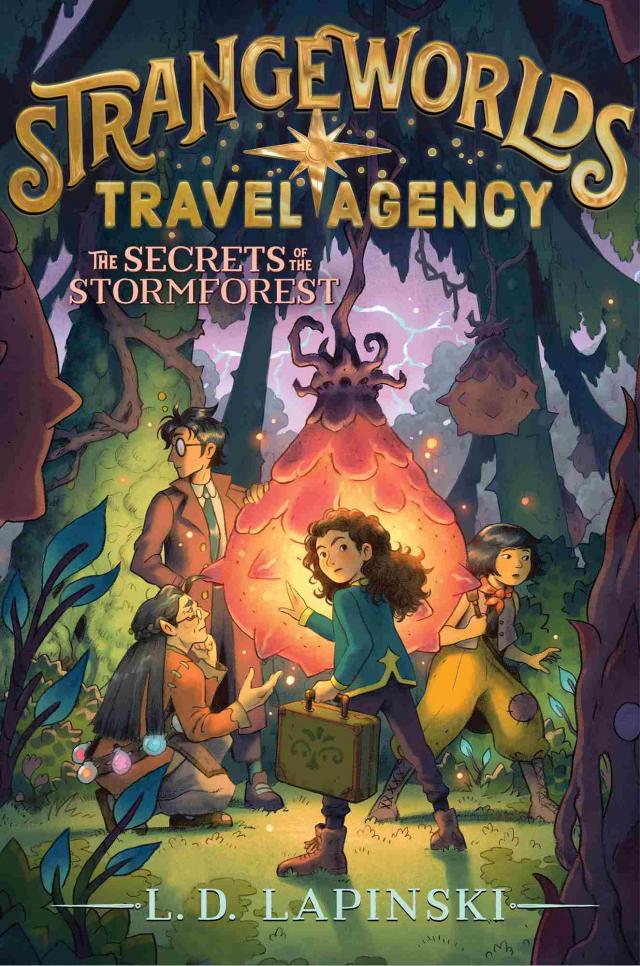
The secrets of the storm.., p.1
The Secrets of the Stormforest, page 1


For Alice and Avery
and for everyone who has joined Flick, Jonathan, and Avery on their adventures
“Cowards die many times before their deaths; The valiant never taste of death but once.”
William Shakespeare
Julius Caesar
(Act II, Scene II, Line 34)
LITTLE WYVERNS
NOVEMBER 1873
The evening the stranger arrived ought to have been a dark and stormy night. That would have been more appropriate for our story.
But in reality it was the calmest night Henry L’Estrange had known for weeks. It was, however, a suitably bleak hour; the gas lamp on the other side of the street glowed half-heartedly in the early winter evening. Henry found himself suppressing a yawn, though closing time was still several hours away.
It had been a busy day, by his standards. He’d sold a rather marvelous cruise to one of his regular clients, and arranged train tickets and passage for several others. Henry was looking forward to closing up for the day and heading home. A few dark shapes occasionally passed in front of the bay window—office workers and clerks leaving their jobs. Henry didn’t hold out a great deal of hope of making a sale at this hour—clerks did not tend to make many voyages abroad. He went back to the book he was reading.
The bell chimed as the door opened. He looked up to see a well-dressed young woman, wrapped in a traveling cloak and carrying two suitcases: one, a brown cardboard affair that looked as though it had been dragged through several hedges and back; the other glossy red and small, with shining gold fastenings. The woman looked well-dressed, and her hair was in a sort of bun under her hat. She closed the door quietly behind herself, and Henry stood, giving her a salesman’s smile. “Good afternoon, miss.”
She did not smile back, but gave him a piercing look, then spoke without so much as introducing herself. “The room upstairs. May I sleep there tonight?”
Henry was so astounded he actually sat back down in his chair. Such a question! And asked as if it were the most natural thing in the world! He hardly knew how to answer. “I—I’m not sure if—”
“I can pay you,” the woman said, taking out a heavy-looking purse.
“Are you in some sort of danger, miss?” Henry blurted out. There was no other way of asking.
“Yes,” she said. “I am.”
“I see,” Henry lied, quite mystified. His day had been upended by this strange young woman, and she had only been in the shop for a minute. The suitcases, the money… Something was afoot. The young woman’s clothes were too fine to belong to a servant, but they were travel-worn. There was dirt and loose threads on the hem of her dress. She was clearly running away from something.
Henry was trying to think of what to do, when the woman’s gaze was caught by the maps framed on the walls of the travel agency. “Are these yours?” she asked.
“Yes. Well, we bought them,” he explained, his train of thought completely derailed. “We have a cartographer in Hay-on-Wye who does all the map work. He’s rather good, isn’t he?”
A small smile crept on to the woman’s face, and stayed there. “He has a little skill.”
“A little, miss?”
The woman put her suitcases down, unfastened the worn cardboard one and slipped a gloved hand inside to pull out a leather-bound portfolio. She handed it to Henry, who opened it on his desk.
He gasped.
The portfolio contained maps. Pages and pages and pages of maps. Maps of towns, of countries, of the world, of coastlines Henry didn’t recognize. Each one was meticulously detailed, colorful and practically dripping with rich ink.
He looked up. “Who made these?”
“I did,” she said simply. “I’m a cartographer. Among other things.”
Henry lifted one of the maps by the edge. It was the city of Edinburgh. “This is exquisite, miss. Who taught you?”
The young woman hesitated.
Henry sensed the question was unwelcome and moved on. “I don’t suppose these are for sale? I would be happy to take some of them off your hands, if you need money.”
“I don’t need money,” she said. “Not yet, anyhow. But I do need a place to stay.”
The implication was clear. Henry was torn between his desire to own some of the maps and the sense of unease he felt about this whole meeting. He laid the page down as he tried to come to a decision. In the corner of the map, in fine black ink, was the name Elara Mercator.
She was watching Henry with tired eyes that seemed empty of hope. He knew from her face that she would not ask a third time.
He cleared his throat. “I… should think a single night would be acceptable, Miss Mercator,” he said. “The upstairs is in some disarray, but I am sure we could—”
“Thank you,” she interrupted, her shoulders dropping in relief. “I can sleep anywhere with a floor.” She took the portfolio back, save for the map of Edinburgh, which she left on Henry’s desk. “I would appreciate it if you did not tell anyone I was staying here.”
“I understand.”
“I hope so,” she said, her voice fearful for the first time. “The people looking for me can be terribly persuasive.”
Henry felt a shiver race over his skin. He had the feeling that since he had agreed to give this woman shelter his world had shifted slightly, or perhaps widened, but the change had been so swift and imperceptible that he couldn’t say exactly what was different.
He led Elara up the stairs, where she settled herself quite comfortably in the front room, waving Henry and his lamp away.
“Remember, I am not supposed to be here,” she said, looking up from her position on the floor. “You should lock up as usual, and I shall keep the place in darkness. Everything you do must be as you normally do. Give no one any reason to suspect I am here.”
* * *
By closing time, Henry had almost forgotten about his strange lodger.
But just before the clock struck for seven, the bell over the door clanged as someone came in, and Henry looked up from his account book.
A man and a woman came in, and something about the sight of them chilled Henry to the bone. He couldn’t say precisely what it was. Perhaps it was their height (both of them towered over him), or perhaps it was their overly bright eyes (which flickered eagerly around the room as if searching for something). Or perhaps it was their skin, which was smooth and without wrinkles, but seemed worn-out, like crepe, thin and almost transparent.
“Good evening,” he said, getting warily to his feet.
Like Elara, neither of them returned his greeting. The man moved his head and neck like a snake looking for a mouse. The woman walked over to Henry and took a photograph from her bag. “Have you seen this girl?” she asked, thrusting the picture at Henry’s face.
Henry took it, knowing before he looked that it would be a photograph of Elara. And indeed it was. A formal picture—Elara’s hair scraped back off her face, her back rod-straight as she looked to the right of the lens. She was wearing fine clothes, there were a number of glassy-looking ornaments on the shelves in the background, and beside her was a suitcase.
He lowered the picture. A lifetime of telling untruths to his father about a great many things had made him an accomplished liar. “I’m sorry, madam,” he said, his voice a bored drawl. “I haven’t seen this person.”
The woman did not even blink. “Look again,” she ordered. Behind her, the man had drawn out a magnifying glass and was peering through it as though he fancied himself a detective from a story.
Henry frowned and looked at the photograph again. “I’m sorry, I haven’t seen her. Is she a relative of yours?”
The woman’s nostrils flared. Her eyes seemed to brighten even more. “She was seen coming in here.”
Henry made a confused face, but his back was starting to sweat. “She came in here? When? I have a lot of customers.” He gestured at the account book.
The woman slammed her hands down flat on the desk between them. “Tell me what you did for her and where she went.”
“I don’t care for your tone,” Henry said firmly, meeting her eyes and hoping he sounded braver than he felt. “I’m going to have to ask you to leave.”
There was a bang from upstairs.
The man and woman looked at each other.
Henry, his blood draining into his legs, opened his mouth, but the woman shoved him hard into the wall behind the desk before he could come up with an explanation. The man was already running up the stairs. Henry coughed, winded. Heart racing, he waited for the moment Elara would be discovered and dragged down the stairs….
The man’s heavy footsteps thumped around on the floorboards above, and then there was a snarl of anger. “She’s not here, Sephie!” He stomped back down the stairs.
The woman seethed through her teeth.
Henry wheezed, trying not to look shocked. “I told you,” he croaked. “I haven’t seen her. Now get out of my shop, before I call the police.”
The couple looked as though they would have very much liked to stay and make Henry’s life a misery, but with a shared glance, seemed to decide against it.
Henry watched them sweep out of the shop and disappear down the street. He was trembling from head to foot, and there was a throbbing pain in his back from where he’d hit the wall.
He wasn’t foolish enough to rush upstairs to check on his guest. Those people might yet be watching him through the window. He dusted his waistcoat off, rubbed some life back into h
It was quite a while later that he heard footsteps on the floor above.
Henry left his desk and went into the small room at the back of the shop to find Elara Mercator hovering halfway down the staircase. “Are they gone?” she asked.
“For an hour or more, now,” he said, filling the kettle from the copper tap. He set it on the stove and lit the flame.
“Did they hurt you?” she asked.
“Not much,” he said bravely, though his back did still ache. “Who are they?”
Elara bit her lip. “They’re dangerous. That’s all you need to know.”
“The man went upstairs. How did you hide from him?”
“It’s a long story.” She came into the kitchen and helped herself to a chair, sitting down with a sigh. She suddenly looked exhausted.
“I have time to listen,” Henry said, “if you want to tell me.”
“It’s quite unbelievable,” she said.
“And full of secrets, no doubt,” Henry replied with a small smile, taking the remaining chair at the table.
Elara nodded. She looked into his eyes and seemed to make a decision. “Those people,” she said, “they aren’t… people. Not as you know them.”
Henry, thinking of their too-bright eyes and papery, smooth skin, thought this wasn’t so unbelievable after all. “What are they?”
Elara took a deep breath and then began.
We are called the Seren,” Tristyan said. “And it is my people who created schisms.”
These words had been echoing through Flick’s mind for what felt like an eternity—though in reality it had only been seconds. But in those few seconds, sitting in Tristyan’s apothecary shop in another world, everything she thought she knew about herself, about her world, about magic and the multiverse, had all been turned upside down in a flash.
She looked over at Jonathan, standing beside her, looking as shocked as she felt, and then back at Tristyan. She realized her mouth was hanging open and tried to remember how to speak.
“They—you—created—” She shook her head. It felt extremely full.
“Schisms are natural phenomena,” Jonathan said. “They have always existed, they weren’t created by anyone. Although”—he gave Flick a look—“I suppose we do know that new ones can be torn, by some people.”
Flick, meanwhile, continued to stare at Tristyan. Until a few minutes ago, she had thought this tall, elf-like man was nothing more than a kind apothecary who sometimes helped out travelers from other worlds. But now she was cradling the revelation that he was her grandfather. Her own dad’s dad was from another world. And therefore, so was she. In a way. Her whole life had been turned upside down as quick as winking.
Felicity Hudson and her friend Jonathan Mercator were part of the Strangeworlds Travel Agency—custodians of a very powerful magical travel system contained within the dozens of suitcases stacked in an old and dusty shop. Within each suitcase was a schism—a gateway to another world—and to travel from one to another, all you had to do was step inside.
Schisms didn’t only exist within suitcases, however; they occurred naturally everywhere. At least, that is what Flick and Jonathan had been led to believe. To hear that the rips and tears in the fabric of the multiverse had been created was like learning that someone colored in the sky every morning. It seemed too far-fetched to be true.
“I don’t understand,” Flick said. “What is a Seren? Am I part Seren?”
Tristyan shook his head. “Let me explain properly. Please?” He indicated the chairs, and they each carefully took a seat.
Jonathan was still clutching the piece of paper in his hands that had given him hope that his missing father was still alive. Daniel Mercator, the true Head Custodian of Strangeworlds, had been missing for months, and presumed dead. But Tristyan had shown them with this scrap of paper that Daniel could still be alive, somewhere out there in the multiverse.
“The Seren are not a species,” Tristyan said, lacing his spidery fingers together. “They are an organization, not unlike the Strangeworlds Society. The difference is, once you are one of the Seren, you are expected to remain one for life. They become your family, your whole world.”
“And where does inventing schisms come into this?” Jonathan said, clearly not in the mood for sentimentality.
Tristyan gave him a small, sad smile. “Contrary to what you’ve been told, young man, schisms have not always existed. There was a time, thousands and thousands of years ago, when the worlds of the multiverse were free of schisms and tears. The worlds existed alongside each other but without any knowledge of one another, and certainly no travel between them. And in a world on the other side of reality from yours, there were the Seren.
“They were not a bad people, not in the beginning. They consumed magic to survive, in the same way you consume food and water. Since living things also produce magic simply by existing, there was plenty of excess magic to keep their world spinning happily. At first.”
“I think I know where this is going,” Flick said. “It’s like natural resources in our world, right? They got greedy. That’s what happened with the Thieves in Five Lights—they bottled so much magic that their entire world was damaged almost beyond repair.”
“Exactly. The Seren are just like the Five Lights Thieves, only on a much larger scale.” Tristyan gave a sigh. “They began to use magic to make other things—spells, and so on—and, as they grew more ambitious, their consumption of magic grew. Eventually, they were using it up faster than it could ever be replenished. And the walls of their world became thin.”
Flick sat up. “And a schism tore?”
“The first schism,” Tristyan said. “The first, and the largest. The schism tore their world to pieces, and the aftershocks of that opened schisms across the multiverse. When it happened, a few of the Seren tumbled into another world and survived. The rest of their people were lost.”
“That’s a sad story,” Flick said.
“Don’t be fooled,” Tristyan said. “Their story does not end there. Rather than learning from their mistakes and beginning their lives again peacefully in this new world, using magic in moderation, the surviving Seren simply picked up where they had left off. They would move from world to world, using magic to extend their lives, escaping through schisms as each world they touched died in their wake. The Seren are no longer a people—they are a virus. I am certain that it is they who caused the initial damage to the City of Five Lights, and I am positive it was they who were taking the magic of the Break in such frightening quantities.”
Flick tried to process what she was being told. “They destroy worlds? On purpose?”
“That’s right,” Tristyan said. “Though they have been quiet for a long time. I thought they might even be gone forever. Wishful thinking. What happened in Five Lights and the Break shows that they are back. The Seren are the biggest threat to the multiverse there has ever been.”
“And you were one of them?” Flick asked, incredulous.
“Not by choice,” Tristyan said. “As the Seren’s power grew, they… took, for want of a better word, children who were magically gifted, children who could help them harness even more magic. They raised us within the Seren and taught us to be one of them. I knew no better. I thought I was on the side of the good guys, until I met Aspen Thatcher, from the Strangeworlds Society.” He smiled sadly. “She showed me what the Seren really were.”
“So, you escaped?” Jonathan asked.
“I did.” Tristyan nodded. “Though I was not the first person to do so.”
“Other people have run away from them?” Flick asked. “Who?”
Tristyan gave her a wry look. “Can’t you think of anyone who was extremely magically gifted? Whose powers seemed to come from nowhere? Someone who did everything they could to keep the worlds of the multiverse safe from danger?”
Flick put a hand to her mouth.
Jonathan sat up sharply. “You don’t mean to say that…?”
“Yes.” Tristyan nodded. “The first person ever to escape the Seren was your very own Society founder, Elara Mercator.”






