

Collectibles, p.1
Collectibles, page 1
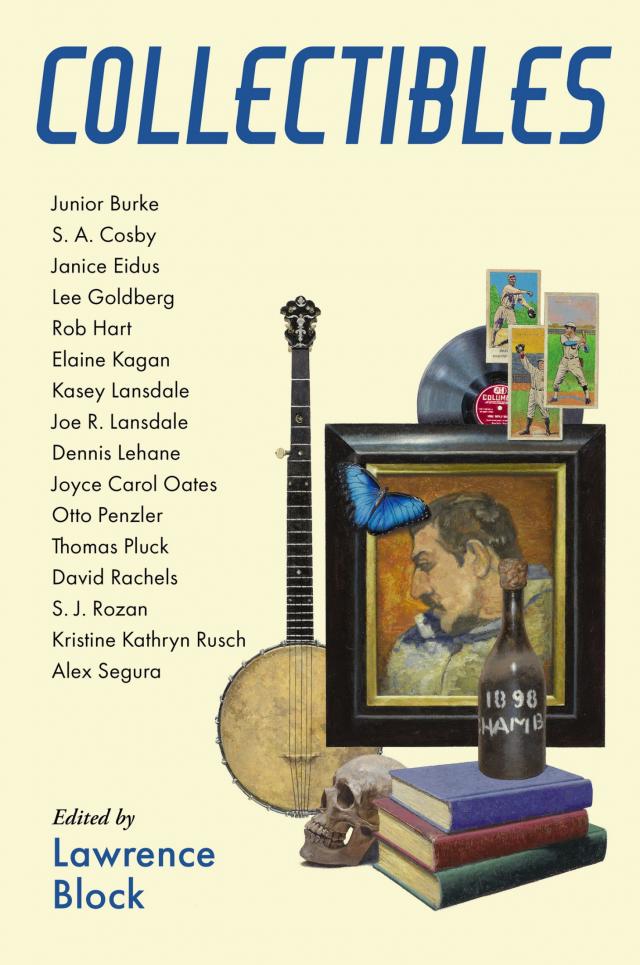


Collectibles
Edited by Lawrence Block
Collectibles Copyright © 2021 by Lawrence Block. All rights reserved.
“The Evan Price Signature Model” Copyright © 2021 by Junior Burke. All rights reserved.
“Blue Book Value” Copyright © 2021 by S. A. Cosby. All rights reserved.
“. . . from Otto Penzler’s Mysterious Obsession (1)” Copyright © 2021 by Otto Penzler. All rights reserved.
“A Collection of Friends” Copyright © 2021 by Janice Eidus. All rights reserved.
“Lost Shows” Copyright © 2021 by Lee Goldberg. All rights reserved.
“Bar Wall Panda” Copyright © 2021 by Rob Hart. All rights reserved.
“God Bless America” Copyright © 2021 by Elaine Kagan. All rights reserved.
“. . . from Otto Penzler’s Mysterious Obsession (2)” Copyright © 2021 by Otto Penzler. All rights reserved.
“Resonator” Copyright © 2021 by Kasey Lansdale. All rights reserved.
“The Skull Collector” Copyright © 2021 By Bizarre Hands, LLC. All rights reserved.
“A Bostonian (in Cambridge)” Copyright © 2021 by Dennis Lehane. All rights reserved.
“Miss Golden Dreams 1949” Copyright © 2021 by Joyce Carol Oates. All rights reserved.
“. . . from Otto Penzler’s Mysterious Obsession (3)” Copyright © 2021 by Otto Penzler. All rights reserved.
“The Green Manalishi with the Two-Pronged Crown” Copyright © 2021 by Thomas Pluck. All rights reserved.
“Devil Sent the Rain Blues (Pm 13040)” Copyright © 2021 by David Rachels. All rights reserved.
“Chin-Yong Yun Meets a Mongol” Copyright © 2021 by S. J. Rozan. All rights reserved.
“The Demise of Snot Rocket” Copyright © 2021 by Kristine Kathryn Rusch. All rights reserved.
“. . . from Otto Penzler’s Mysterious Obsession (4)” Copyright © 2021 by Otto Penzler. All rights reserved.
“First Appearance” Copyright © 2021 by Alex Segura. All rights reserved.
“Collecting Ackermans” Copyright © 1977 by Lawrence Block. All rights reserved.
Cover illustration Copyright © 2021 by Ken Laager. All rights reserved. Cover provided courtesy of and used with permission of Subterranean Press.
Interior by JW Manus
A LAWRENCE BLOCK PRODUCTION
Table of Contents
The Elephant in the Living Room
(an introduction)
Lawrence Block
The Evan Price Signature Model
Junior Burke
Blue Book Value
S. A. Cosby
. . . from Otto Penzler’s Mysterious Obsession:
Introduction
A Collection of Friends
Janice Eidus
Lost Shows
Lee Goldberg
Bar Wall Panda
Rob Hart
God Bless America
Elaine Kagan
. . . from Otto Penzler’s Mysterious Obsession
Mémoires de Vidocq
Francoise-Eugene Vidocq
Resonator
Kasey Lansdale
The Skull Collector
Joe R. Lansdale
A Bostonian (in Cambridge)
Dennis Lehane
Miss Golden Dreams 1949
Joyce Carol Oates
. . . from Otto Penzler’s Mysterious Obsession
Lingo Dan
Percival Pollard
The Green Manalishi with the Two-Pronged Crown
Thomas Pluck
Devil Sent the Rain Blues (Pm 13040)
David Rachels
Chin Yong-Yun Meets a Mongol
S. J. Rozan
The Demise of Snot Rocket
Kristine Kathryn Rusch
. . . from Otto Penzler’s Mysterious Obsession
Red Harvest and The Maltese Falcon
Dashiell Hammett
First Appearance
Alex Segura
Collecting Ackermans
Lawrence Block
About Our Contributors
About Lawrence Block
The Elephant in the Living Room
Lawrence Block
* * *
BEN: Ah, there you are. Just the man I’ve been looking for.
JERRY: Who, me?
BEN: Absolutely. I’m able to offer you something I know you’ll love, and at a remarkable price.
JERRY: What? I’ve got everything I need.
BEN: This you haven’t got.
JERRY: So? What is it?
BEN: An elephant.
JERRY: An elephant? Are you out of your mind?
BEN: But—
JERRY: I live in two rooms on Pitkin Avenue. Two small rooms on the fifth floor. I got no room for a goldfish, never mind an elephant.
BEN: But—
JERRY: There’s no backyard, just ten square feet of garbage cans. There’s no front lawn, just a stoop. And out in front there’s a fire hydrant, so you couldn’t even park a Ford Escort there, let alone an elephant.
BEN: But—
JERRY: So where would I put it? I got no place to put it, and if I did I wouldn’t be able to keep it alive, because I’m lucky I can afford to feed myself. I couldn’t feed an elephant, and if I could, how am I gonna clean up after it?
BEN: But—
JERRY: And what would I want with it in the first place? You think I’m gonna ride around on an elephant? You think I’m gonna walk it on a leash? I got no use for an elephant, I got nothing to feed it with, I got no place to put it, so I ask you again what I asked you in the first place. Are you out of your mind? Because why in God’s name would somebody like me want to buy an elephant?
BEN: You put it that way, Jerry, sheesh—I guess you wouldn’t.
JERRY: That’s what I’ve been trying to tell you.
BEN: I hear you, and I have to say it’s disappointing. Because what I didn’t get to mention is that I’ve come into possession of not one but two elephants, and I could give you a very special price if you were to take them both.
JERRY: Now you’re talking!
Now it’s true that Jerry’s not so much a collector as he is a bargain seeker, but I have a feeling most ardent collectors would get the point. And another conversation between the same two gentlemen has its own point to make:
BEN: This whole retirement is horrible. I got nothing to do and too much time to do it in. I’m going nuts.
JERRY: That’s natural. You worked hard all your life. You were always busy with one thing or another, and now you have nothing to do.
BEN: Isn’t that what I just told you?
JERRY: It is, and there’s an answer.
BEN: Oh?
JERRY: You need a hobby.
BEN: A hobby?
JERRY: A hobby.
BEN: What, like collect stamps and paste them in a book? Do jigsaw puzzles? Crochet lamp shades? That’s gonna fill my days with joy?
JERRY: I’ll tell you something. It doesn’t matter what the thing is that you do. What matters is that you’re doing it. You take an interest, you get caught up in it, and your life becomes a pleasure instead of an aggravation.
BEN: I think you’re serious.
JERRY: I am. Hundred percent.
BEN: And you? You also worked hard all your life. Now you got a hobby?
JERRY: As a matter of fact, I do.
BEN: Yeah? You care to tell me what it is?
JERRY: I keep bees.
BEN: You? My old friend Jerry? You keep bees?
JERRY: Yes, I do. As a hobby.
BEN: Bees. How many have you got?
JERRY: Well, it’s not like you can stand there and count them—
BEN: Round numbers.
JERRY: Round numbers, probably forty thousand.
BEN: Forty thousand bees.
JERRY: More or less.
BEN: Forty thousand bees. You live in two rooms on Pitkin Avenue. Where the hell do you keep them?
JERRY: Well, as a matter of fact, I keep them in a cigar box.
BEN: Forty thousand bees in a cigar box?
JERRY: So?
BEN: So how can that be good for them? Don’t they get all crushed and crumpled?
JERRY: So? Get a grip, Ben. It’s only a hobby!
∗ ∗ ∗
On reflection, I’d say we can all be grateful these two guys moved to Vermont to make ice cream. Let’s move on. Let’s talk about Collectibles.
Once I’d settled on the theme for this anthology, I got busy dragooning contributors. Their stories, I explained, could be in any genre or no genre at all, and could concern any sort of collectible item.
What I wanted, what I always want when I’m wearing my anthologist hat, is to provide a grain of sand that will sufficiently irritate a writer to yield a pearl of a story. And, I’m pleased to report, that’s precisely what’s happened here. The stories don’t need me to speak for them. They require, as one might say, no introduction.
So what am I doing here? Besides recycling old jokes that were briefer and more to the point when I first heard them?
Well, I ought to explain the one byline that appears not once but four times in the Table of Contents. The name is Otto Penzler’s, and a well-known name it is, although the affable fellow who bears it is not a writer of fiction.
In the fall of 2019, when Collectibles was just beginning to take shape, Otto was good enough to send me a copy of Mysterious Obsession, a new memoir he’d published that centered on favorite books he’d collected over the years. H e was, as you may know, not only an authority in the field of crime fiction and an editor and publisher of some of the best of it, but without question the world’s foremost collector thereof. His is a book to be taken in small doses, made for sipping and savoring, and I knew as much—but what I found was that once I’d picked it up myself I couldn’t put it down until I’d drained the metaphorical glass—to the dregs, I might say, but there was not a dreg to be found.
It seemed to me that a chapter extracted from Mysterious Obsession would be a welcome addition to Collectibles. But which chapter? There wasn’t a one that wouldn’t suit . . . nor was there one long enough to constitute a full chapter in my book.
You can see how I solved the problem.
∗ ∗ ∗
Otto’s are not the only words in this volume to have already appeared elsewhere. There’s also a story called “Collecting Ackermans,” which appeared in Alfred Hitchcock’s Mystery Magazine in 1977. The author was, um, Lawrence Block.
I always feel that any anthology with my name on the cover ought to contain a story of mine. This is an ideal often honored in the breach, especially of late, when my own creative juices have gone largely dry. This figures, after all; one embraces the practice of anthologism because it offers one a chance to appear writerly without actually writing anything.
Except, you know. Introductions.
So what I did, as usual, was enlist enough fine writers to fill a book. I get to decide for myself just how many that is, but somewhere along the way I seem to have settled on seventeen, and I’ve been compulsive enough to stick with it. Not like barnacles to the hull of a ship, or iron filings to a magnet. I’ve put together books that have exceeded or fallen short of that number. But I shoot for seventeen, and hit it most of the time.
I totted up my acceptances and was relieved to see that I had eighteen acceptances, or nineteen with Otto’s contribution. So Collectibles could get along without a Lawrence Block story.
Then Covid, and a world turned upside-down. And a couple of writers found themselves unable to produce stories. I was down to fifteen stories, sixteen counting Otto’s.
Could I write one?
I thought about it, and kept being struck by the fact that I’d already done so, that “Collecting Ackermans” was an ideal choice for the book. I read it to see if I still liked it, and guess what? I thought it was just fine.
Seventeen!
∗ ∗ ∗
I’ve been a collector of one thing or another for most of my life. In childhood I amassed no end of collections. I netted butterflies in vacant lots, I soaked stamps off letters, I checked pocket change for dates and mintmarks. When reading became important to me, I collected books; when I started writing crime fiction, I collected the magazines that published it. Whenever I acquired an object that interested me, I wanted to add others that were of its ilk but slightly different.
I could list some examples, and then we’d have a collection of nouns.
The impulse has been with me in one form or another since childhood. Only recently has it abated, and after I sold my stamp collection a few years ago, there’s been nothing I’ve felt the need to collect.
I can only assume it’s age-related. Ecclesiastes would understand. I’ve grown beyond the time to gather stones and reached the time to cast them away.
Good job I’m not in a glass house.
∗ ∗ ∗
But let’s end where we began, with the elephant. My Uncle Jerry Nathan, the younger of my mother’s two brothers, had collected stamps as a boy, and had been an ardent ornithologist as a young man, but I don’t recall his having collected anything in adulthood. Until perhaps his sixtieth year, when he announced with satisfaction that he’d begun collecting elephants. Not living ones, not the kind you’d house in two rooms on Pitkin Avenue, but the sort of carvings you put on one of those shelves designed to hold, um, carvings.
And indeed he had a couple of shelves in his living room, and there was a set of elephants on one of them. All the same elephant, really, in graduated sizes. I think he bought that first set, and then it became something to give him. “Oh, there’s an elephant, I think I’ll get it for Jerry.” And so the collection grew. Not to any great size, really, and I don’t remember anything noteworthy about any of the elephants, except that some were wood and some were not.
Never mind.
It must have been a couple of years after Jerry came down with his mild case of elephant fever when my cousin Jeffrey Nathan announced he’d begun a collection. (Jeffrey was the younger son of my Uncle Hi, my mother’s other brother. You don’t need to remember this. It won’t be on the test.)
I asked him what he was collecting. “Giraffes,” he said.
A commendable choice, I told him. And we agreed that the giraffe was an attractive and distinctive and noble beast, and eminently collectible. And even its name was appropriate; Jeffrey and Giraffe were well suited to share space in the same sentence. He talked for a few minutes about his collection, the aptness of it, the opportunities it afforded. He confided that it had been several months since the idea came to him, several months since he’d become a collector of the long-necked creatures. And then I had a question. I asked him how many giraffes his collection contained.
“None,” he said.
None?
He explained that he hadn’t yet found a specimen that was quite up to the standards of his collection.
A couple of years later Lynne and I came across a giraffe somewhere and thought it was too good to pass up. Perfect for Jeffrey, we agreed, and bought it, but it was not without a degree of trepidation that we mailed it off to him. His collection, still without a single specimen, was pristine and perfect. Would we be lowering its tone?
Jeffrey called to thank us for the gift, and was quick to lay my concern to rest. “It fits the collection perfectly,” he assured me. “It’s just right.”
Well, really, what else could he say? But I’m still not sure we did the right thing.
The Evan Price Signature Model
Junior Burke
* * *
I opened The Fret Gallery mostly to have a place to keep my instruments. When I went from being a full-time musician to a part-time musician to a once-in-a-blue-moon musician, my wife Marlene inquired, at first occasionally, then with more frequency, did I really need twenty-two guitars?
Truth was, I’d never sold a guitar, never traded one in. Every time I hooked up with a new group, I’d get a fresh one. For a rock cover band, another electric; a bluegrass ensemble, another acoustic. I bought them used, always a Gibson, Fender or Martin, each one now more than thirty years old. If I’d owned a guitar, played it on the bandstand or in my music room at home, it became part of me. Sound waves never die and those guitars were the chatter of my life.
“You have to open a store to sell them?” Marlene asked. “Why not just put them up on eBay?”
What I wasn’t telling her was I had no intention of selling them, not any of those. Guitar manufacturing had gone much the way of the auto industry. What was now termed classic or vintage guitars were American, made before the final decade of the twentieth century. The ones for sale would be new, most of them assembled in Mexico or Japan; China or Korea. Mine would hang on their own wall, to be looked at, taken down and played, not part of the commercial inventory.
Being in Dillard’s Grove, thirty miles south of Chicago, a town of forty-two thousand, I wasn’t expecting to make a fortune. A few years in, I was banking more than I was spending, largely because I augmented the guitars and their accessories with vinyl. That, like the offshore guitars and amplifiers and effects pedals, was what the kids wanted.
One afternoon I was in the shop when Tad Kilmer came in. While he held a guitar case, his visit struck me as random, as I hadn’t laid eyes on him in ten, fifteen years.
We expressed our pleasure in seeing each other, then Tad said, “I didn’t know where else to take this, Andy. The family finally sold the motor lodge, in fact it’s being torn down tomorrow. I found this in a shed out back, buried under a stack of boxes.”
The case appeared spanking new. Tad set it flat on the counter, then we both flipped up a couple of latches. The guitar was cherry red and shiny, silver hardware gleaming; a dual-pickup, semi-hollow single cutaway, with rosewood neck and bridge. The name on the headstock said Gibson, although I’d never seen one like it.






