The danger key km 016, p.1
The Danger Key (KM 016), page 1
part #16 of Killmaster Series
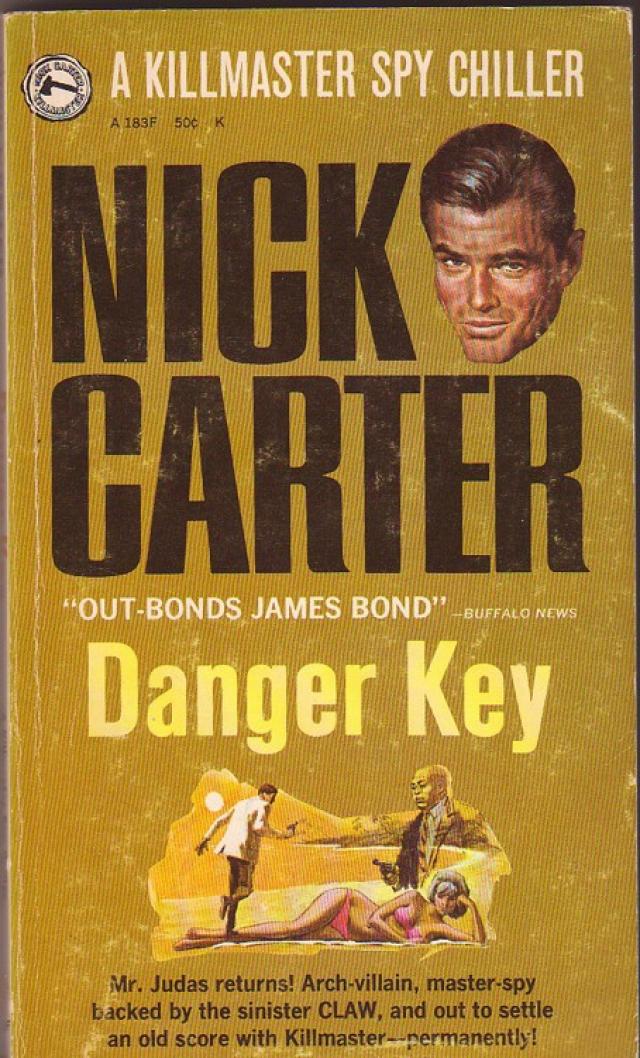


The Danger Key (1966)
(Book 16 in the Killmaster series)
Version 0.9
Dedicated to The Men of the Secret Services of the United States of America
Chapter 1
She was not altogether naked.
A wispy triangle of white silk was tucked about her tanned, shapely midsection, while a matching fragment fought a losing battle to restrain twin mounds of full, sculptured loveliness.
Her ash-blonde hair streamed out behind in a way that made it seem almost part of the speeding white convertible.
The causeway along which she was hurtling was a fragile ribbon of concrete against the vast expanse of un-rippled blue water. A quarter of a mile down its length stood the fisherman.
He smiled as he watched her approach—a wide, handsome smile that matched the girl, the car, the Florida keys in season. As she slowed, turning off onto the causeway’s narrow shoulder, he waved cheerfully and reeled in his line, and the blonde waved back and blew him a kiss.
Love and leisure in a warm climate—what more could a man ask for?
The car suddenly surged forward, tires screaming against the tarmac. The fisherman’s smile disintegrated. He stumbled backward, fell. The grillwork caught him full in the face, hurling him back against the guard rail. The blonde spun the wheel hard. With a grating roar of metal, the car sideswept the rail, peeling the man off it as if he were an extra coat of paint. His body vanished beneath the wheels. The blonde brought the car to a skidding stop. Glancing over her shoulder, she threw it into reverse and shot back over the crushed, broken remains, then forward again—and this time she didn’t stop.
Captain Clegg’s charter fishing boat had come hugging out from under the causeway in time for him to see the blonde in the white convertible roar away. The hit-and- run victim was still alive when he reached him.
“Mister, what happened?” he asked. “Can you hear me?”
The face was a bloody mask from which the features had been wiped as if by a rag. Eyelids fought their way open. Sightless eyes stared into his—puzzled, interrupted in important work. Mucus, spotted with blood, ran down what was left of a chin. The raw meat of the lips moved, the throat thickened as the muscles in it worked. “Pa …” The man took several chugging breaths. “Pa … okay …” he gasped.
Then the strength was gone. The eyes rolled back to their more important work. The remains of the face went slack.
Robyn’s pale white limbs glimmered in the firelight. She was kneeling on the cushions of the couch, superbly naked, legs drawn up under her, the tinted nipples pointing, her lovely face flushed, her blue eyes bright with impatience. She put down her martini glass and said “Mmm” as Nick Carter entered, fresh from the shower. She tugged at the towel which he had modestly looped around his middle. It came away easily. “Double mmm,” she murmured as she studied his readiness. Nick slid onto the couch beside her, his hand moving down over her taut little buttocks. He leaned forward, his lips brushing the back of her neck lightly.
The sharpness of the telephone’s jangle made them both start.
“Oh, no!” she wailed. “He promised!”
“Robyn, other people do have my number,” said Nick, as he reached past her and picked up the phone. He said only four words into the receiver. “What time?” and, after a pause, “All right.” And Robyn knew from the set of his jaw and the way the steel-gray eyes had switched from hot to cold that it was them. AXE—America’s super-secret counterintelligence agency.
“Two hours until plane time,” he said to her now. “Will you bring the car back into Manhattan?”
“Oh no!” she repeated brokenly. “He promised that this time you’d have your full vacation.”
Nick said, “He wouldn’t send for me if it wasn’t really important.”
Robyn nodded through her tears. She knew that was so. They were in the same deadly business. And she was just as likely to be called suddenly to a new assignment. She sat bolt upright, wiped at her eyes with the back of one hand, and said, “It’ll only take us an hour to get out there. Let’s make the most of the time left.”
Nick grinned. That was his Robyn. He thought back over the dozens of assignments and the dozens of lovely girls who had come between them over the years. Few of them could match her, for she alone understood that the telephone always had to be answered—that he was, in short, agent N3 of AXE, and that his life was not his own.
“Let’s see,” he mused, “where was I?” Robyn pointed to the back of her neck and, with a smile, he bent to kiss it, his hands moving up over her full, lovely breasts, feeling the nipples stiffen beneath his caresses.
It was after midnight when Nick Carter’s plane landed at National Airport, and it took his cab more than an hour to reach downtown Washington through the snow-snarled streets. A raw March wind was blowing off the Potomac as he hurried into the Amalgamated Press and Wire Service Building on Dupont Circle. The night security man took him straight to the sixth floor. Not to Hawk’s office, however, but to the projection room. All very strange, thought Nick, and with the smell of emergency about it.
Hawk’s presence in the building at this ungodly hour suggested the same thing. The head of AXE was fanatical about keeping regular office hours. But here he sat, hunched forward in his seat in the smoky gloom, looking tense and impatient.
“Sorry about the delay, sir,” said Nick. “Weather foul-up.”
“Sit down, N3.” Hawk pressed a button at the side of his seat and picked up a small hand mike. “You can go ahead,” he told the projectionist. “Make sure the film clips are in the correct sequence.”
A Boeing 707 appeared on the screen. It was taxiing to a stop. The airstair was rolled out to it, followed by a cluster of health and immigration officials.
“Eight hundred a week,” said Hawk, speaking around the dead cigar in his thin-lipped mouth as the two men stared at the screen. “That’s the rate at which the Cuban refugees have been airlifted in to this country over the past year. Aliens from a Communist country with which we have no diplomatic relations, no intelligence cooperation,” he added, with a sidelong glance at his top operative. “A security nightmare. It’s almost as if we had thrown the gates wide open and invited every power to send in their top people.”
The Boeing’s door was open now, the airstair in place, the health and immigration officials standing to either side of it. A stewardess propelled an empty, folded wheelchair onto the platform and the officials handed it along to the bottom of the stairs, where an attendant opened it. “Here’s our man now,” said Hawk, as three more stewardesses appeared in the 707’s doorway. Between them they supported a feeble-looking old man wrapped in a heavy overcoat and scarf, his hat pulled down over his head. He was wearing mittens.
Hawk pressed the button. “Sound, please,” he said to the projectionist.
“… first off the plane is the oldest passenger, 72-year- old Julio Fernandez Romero of Matanzas, Cuba,” announced a voice on the soundtrack. “He is sponsored by his son and daughter-in-law, Mr. and Mrs. Eduardo Romero of Fort Myers.”
“This sequence was taken eleven months ago,” said Hawk, “at Miami International Airport. The CIA photographs every arriving refugee. But, as with all the other elaborate screening procedures, it’s simply inadequate to the task.”
Nick shot him an inquiring glance. Hawk was chewing his cigar savgely. “Any Boy Scout of average intellgence, let alone a professional espionage agent, could waltz through all our precautions in five minutes flat. As a matter of fact, they have. AXE agents have come in from Cuba with the refugees and have passed through the Opa-locka Detention Center undetected.”
Nick’s dark eyebrows rose in surprise. “And this Romero,” he said, turning back to the screen and watching as the stewardesses helped the old man down the stairs. “Whose little boy is he?”
“We know one thing,” replied Hawk. “He isn’t Julio Romero of Matanzas. That Romero never left Cuba. His body was found buried in a shallow grave near Varadero Airport some three weeks after this man arrived in Miami. The Cubans immediately notified U.S. authorities, but by then it was too late, of course.”
“He’d already been processed through Opa-Locka?”
Hawk nodded sourly. “His son and daughter-in-law had picked him up and started back to Fort Myers. Perhaps they saw through his disguise. At any rate, they didn’t get very far. They were found murdered thirty miles outside Opa-Locka. On the highway that runs through the Everglades. The Tamiami Trail, is it?” He opened a folder on the seat beside him and handed Nick a paper. “Here’s the official report.”
Nick scanned it quickly. “The thirteen-year-old granddaughter, too,” he said grimly.
“Very slick job,” replied Hawk. “Weeks were wasted on the rape angle alone. And the savagery of the throat slittings—it all looked very spontaneous. An abandoned, blood-soaked car. The bodies dragged into the swamp. Signs of a struggle. The old man missing but for quite a while presumed kidnaped because of the manner in which he was dragged from his wheelchair along the ground to the other car. Very slick, indeed. The local police blundered about for weeks before the CIA uncovered the fact that the real Romero had never reached the U.S.—at which point they took over.”
“And when did AXE enter the picture?”
A faintly pained look crossed Hawk’s face. “Too late, I’m afraid, to do anything but pick up the pieces. Now here,” he said abruptly, pointing to the screen. “This is interesting. Watch carefully.” Nick did as “Julio Romero” was lowered into the wheelchair at the bottom of the airstair. Suddenly his hat was knocked askew by those helping him and his face became momentarily visible between their ministering forms. “Hold it there,” said Hawk, speaking into the mike. “The closeup, please.”
The projectionist made some adjustments, and the face—magnified a dozen times—flashed on the screen. The first thing Nick noticed was that it was curiously smooth and unlined for a man of his apparent age. Near the hairline were barely visible marks, possibly scars.
“If two of the three CIA agents working on the Romero case hadn’t been killed in very suspicious hit-and-run accidents earlier this week,” said Hawk, “chances are I wouldn’t have had this sequence replayed. How serious that would have been, you’ll see when we run it over in slow motion.”
While the projectionist rewound the film, Hawk briefly summarized the CIA’s ten-month investigation of the Romero case. Nelson Machado had covered the Cuban end; Juan Ochoa, Florida. Their control was Miami-based Ralph Benson. “Machado’s reports,” said Hawk, pointing to a thick manila folder on the seat beside him. “Required reading. Interpreted individually, they don’t add up to much,” he said, “but the cumulative effect is quite different. Harrowing is almost too mild a word. You’ll see what I mean.”
“Was Machado one of the hit-and-run victims?”
Hawk nodded. “The other was Ochoa,” he said. “He was killed yesterday while fishing on a causeway in the Florida keys. He was on to something. What, we don’t know—thanks to Benson,” he added acidly.
Although Ochoa had acted with incredible stupidity, Hawk held his control responsible for the resulting mess. “Ochoa was not a professional,” he said. “He was a Cuban refugee recruited by the CIA to keep them informed on developments in Miami refugee circles. He should never have been on a case like this. Or, if on it, he should have been kept on a tight leash. Instead, Benson allowed him to roam far afield and to report at infrequent intervals.
“On the morning he was killed,” Hawk continued, staring fiercely at his dead cigar, “Ochoa called Miami control—on an open line, mind you—from Big Pine Key and told him that he was on his way to meet some woman he’d gotten involved with. He asked Benson to meet him that night at a certain cocktail lounge on Marathon Key, that he’d have the Romero case wrapped up by then and would give him all the details.”
Nick couldn’t suppress a grim smile at the mounting list of deadly errors. “Did Benson go?” he asked, not really believing it possible.
“He did,” replied Hawk. “And not only that. When Ochoa didn’t show, he drove on out to Big Pine and made inquiries about him.” Nick shook his head in amazed disbelief. “Of course he didn’t come right out and say where is so-and-so, the CIA agent,” Hawk continued dryly. “He posed as a reporter from some magazine interested in interviewing the famous Peruvian sports fisherman, Pedro Villareal. That was the cover Ochoa had been using.”
“Benson sounds like the prime candidate for a third hit-and-run accident.”
Hawk shot him a funny look. “If that happens,” he said, “you’ll be the first to know about it.” Nick stared at him. The head of America’s super-secret intelligence agency was not smiling, however. His leathery features were deadly serious. He said: “The real Benson has been brought in from the cold, as they say. You’ll take his place. He’s your height, your general build. Editing will match your appearance with his and will provide you with the necessary personality dossier, plus recordings of his voice which you can study. You will then return to Big Pine Key and continue to bumble clumsily about. Our hope is that Ochoa’s call to Benson was monitored, that Benson himself was observed on Big Pine. On the off chance he wasn’t, though, you’re to make every mistake in the book that will help reveal the fact you’re a U.S. intelligence agent. But don’t overact, of course. You’re to draw the enemy out, not get yourself killed.”
A voice squawked at Hawk’s elbow. He picked up the mike and said, “Yes, run it now, please.”
The overhead lights dimmed and once again the Boeing 707 came taxiing onto the screen—but in slow motion this time. The stewardesses moved with weird, dreamlike slowness as they helped the old man down the airstairs. “Now watch this,” said Hawk, as the man’s overcoat became briefly entangled in the handrail and came open.
Nick whistled softly. His trained eye had immediately noted that the overcoat was not as heavy as it first appeared, but that the torso it shielded was! The man’s age and frailty were largely deceptive. He was actually broad-shouldered, even barrel-chested, and when the film was run a third time, frame by frame, Nick could even make out the bunching muscles of the “old man’s” powerful thighs as they worked to support him.
“The arms and hands are of particular interest,” said Hawk. “Sequence 11-A, please,” he said into the mike. It was the one immediately following the man’s hat coming askew, and showed him adjusting it as a stewardess wheeled him along the tarmac to the arrival area. His arms and hands moved stiffly, as if they were crippled. Or mechanical.
“Now look at this closeup,” said Hawk. It was an amazing magnification job. Clear and sharp. The hands were pulpy and unarticulated inside the mittens—like hand-shaped mudpacks, or inflated rubber gloves. A patch of skin showed between the left-hand mitten and the sleeve of the overcoat. It was shiny, unreal, with an unnatural texture.
Nick felt the hair on the back of his neck rise.
Now he understood the urgency of this late-night briefing. There was only one individual in the world who looked as if he had been put together with bits and pieces of inanimate objects. His machinations, and those of his masters, were the immediate concern of AXE. And the man who knew him best was Special Agent Carter, who had earned for himself the title of Killmaster.
Nick had the film clips run three more times to make absolutely certain. But each viewing only further confirmed the chilling truth—that the master spy and brutal killer for the Red Chinese, the man whose code name was Judas, was here in the United States!
Chapter 2
The battered red sports car wove erratically in and out of the stream of traffic traveling south on the Overseas Highway.
The man behind its wheel wore wrap-around smoked glasses and a gaudy aloha shirt. Charles Mackley, stringer for Pic Magazine, was handsome but graying, with a dissolute air about him. Strictly a wornout item— like the camera and typewriter on the seat beside him and his apartment in a rundown section of Miami.
He gave the car ahead a taste of his horn—a hideous glockenspiel-like racket. Behind his smoked glasses, he winced. For Mackley was not Mackley, nor was he Ralph Benson, the CIA agent to whom this disguise came so naturally. He was Nick Carter, and of all the personality changes that AXE’s Editing Department had engineered for him over the years this one grated against his own nature the most.
Nick had met the real Benson through top-level CIA contacts in Miami and had come away from the meeting with a bad taste in his mouth. A drunk! The man was dangerous—to himself and to others. “It’s like metal fatigue,” was how Benson’s superior had put it to Nick. “Been in it too long. Secret tippling for about six months now. Lucky to be getting out alive. We’ll give him a clerical job in Communications until you’ve finished with his cover, then bounce him.”
Benson was not the only nasty surprise wrapped up in this assignment. Hawk had sprung the other. “You’ll carry none of your usual equipment,” he had told N3. “Judas has dealt with us before. There must be nothing on your person which could alert him to the fact that AXE has replaced the CIA on this case.”
Two chilling thoughts kept pulsing through Nick’s mind, and he knew that they must be giving Hawk nightmares, too. The first was that Judas had already been in the U.S. for almost a year, operating with absolute impunity. The second grew out of Machado’s reports from Cuba. Every other one had dealt with the disappearance of Red Chinese technicians. Peking’s Embassy in Havana had complained that they were the victims of CIA infiltrators and demanded that security be tightened; the Cuban government had denied the allegations and charged, in turn, that the “technicians” were really espionage agents who were being funneled through Cuba to other parts of Latin America. Machado’s own conclusion: they were actually Florida bound, using the refugees’ small-boat exodus to the keys as their cover!