Progeny, p.1
Progeny, page 1
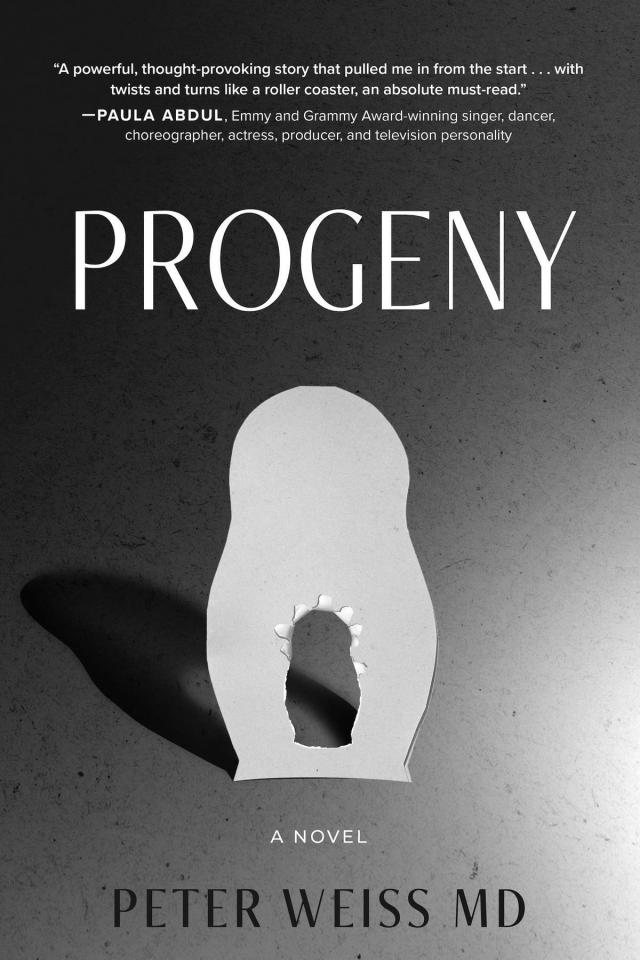


PRAISE FOR
PROGENY
“Progeny is a powerful, thought-provoking story that pulled me in from the start. Peter Weiss writes with vivid emotion, imagining a world that feels unsettlingly possible and asking questions about family, fairness, and what it means to truly value life.
“His words keep you turning the pages while also making you pause and reflect. Progeny has twists and turns like a roller coaster, an absolute must-read.”
—PAULA ABDUL, Emmy and Grammy Award–winning
singer, dancer, choreographer, actress, producer,
and television personality
“From the first page of Progeny, Peter Weiss takes readers on a heart-pounding sleigh ride into a twisted future world where the medical profession and progressive social mores conspire to create a terrifying dystopian reality where human life is revalued. With insight and detail that only an experienced physician can provide—and compassion only a parent can appreciate—Peter paints an excruciatingly vivid portrait of a system that will tap into the deepest fears of parents wired to protect and nurture their offspring at all costs. Peter’s rich and fast-paced storytelling will have readers catching their breaths to keep up. When they do, they will come to the frightening realization that the future he depicts in Progeny may not be far away. A must-read for anyone who has ever been a parent or a child.”
—GUSTAV CARLSON, award-winning international journalist and author of Total Exposure: Controlling Your Company’s Image in the Glare of the Business Media Explosion and Do You Dot-Com: A Field Guide to Understanding Life at an Internet Company
“From Edgar Allan Poe to Robin Cook. From Twilight Zone to Black Mirror. If you crave the sculpting of strange new worlds as told by a writer who shares each description as if knowing from personal experience, you’ll love your journey with Peter Weiss into the world of Progeny.”
—CRAIG HAFFNER, Emmy and Tony
Award–winning film and stage producer
“If you thought Handmaid’s Tale was twisted, just wait until you read Progeny. Stephen King has met his match.”
—NICHOLAS BENJAMIN, award-winning writer and director
“Progeny is a provocative and deeply original novel that explores what could happen when society’s pursuit of equity overrides the most primal human bond: that between parent and child. This is a powerful debut that challenges assumptions and lingers long after the final page. I highly recommend it not only for the page-turning read it is, but as worthy of development as a feature or series destined for multiple screens.”
—DAVE PHILLIPS, executive producer,
former William Morris motion picture agent
“A thrilling story every mother will find compelling. In a world where anonymous and corrupt AI rules: What do you do when the baby you bear is not called your own? Contemplating a world of declining birth rates, climate crisis, intrusive gadgetry, drones and self-driving vehicles, carpets of cameras, all ruled by anonymous and corrupt AI, Dr. Weiss evokes the threat to the basic human right to parent your own children.”
—MICHELE RICHARDS, founder and
CEO of Wonderstruck Studios
“OB/GYN Peter Weiss has written one of the more compelling books on modern medicine. Grab it!”
—ROGER L. SIMON, Academy Award–nominated
writer and author on the award-winning
Moses Wine (The Big Fix) mysteries
“Weiss’s Progeny is a gripping thriller from inception to delivery of its final pages! I enjoyed each moment of this wild ride filled with fact-based medical drama and futuristic science.”
—CARLA ONDRASIK, author of Stop Trying!
“Progeny is a must-read that takes the idea of family and turns it into a terrifyingly honest conversation about fairness. It’s the kind of story that makes you question not just what’s right—but who gets to decide. I couldn’t stop turning pages, wondering how far I’d go to protect what’s mine—or what should even count as ‘mine’ in the first place.”
—JUSTIN L. STERNBERG, Hollywood TV writer, author of YOUR STORY RULES, and former head of storytelling at Snapchat
“Progeny is a gripping, unsettling, and deeply human dystopian thriller. Peter Weiss weaves a story that is as thought-provoking as it is propulsive, reminding us how fiercely we’re wired to love and protect. A powerful debut that lingers long after the final page.”
—RON WEST, Hollywood talent manager and producer and founding partner of Thruline Entertainment
“Peter Weiss’s Progeny is a propulsive read from the very beginning—and I couldn’t stop reading. The first chapter, detailing the difficulties attending a birth, set the scene perfectly. Birth should be an inherently natural process, but in this case, possibly fatal difficulties occur that must be overcome. Progeny is a dystopian novel, and many novels in this genre follow a similar pattern—a society has attempted to address the evils of the past as new leaders emerge and the old rules are changed. In the past, many children were born into circumstances that almost certainly ensured their future failure in life. But what if it were possible to ensure that all children are born with an equal chance? It’s an interesting question, and Progeny addresses the issue: ‘Equity from Birth’ is the government’s slogan. But what does that really mean? And is it even possible?”
—WINONA HOWE, professor emeritus and La Sierra University and author of The Palace in the Jungle, The Penniman Menagerie, and Sita and the Prince of Tigers
PROGENY
Progeny
by Peter Weiss, M.D.
© Copyright 2026 Peter Weiss, M.D.
ISBN 979-8-88824-987-1
All rights reserved. No part of this publication may be reproduced, stored in a retrieval system, or transmitted in any form or by any means—electronic, mechanical, photocopy, recording, or any other—except for brief quotations in printed reviews, without the prior written permission of the author.
This is a work of fiction. All the characters in this book are fictitious, and any resemblance to actual persons, living or dead, is purely coincidental. The names, incidents, dialogue, and opinions expressed are products of the author’s imagination and are not to be construed as real.
Published by
3705 Shore Drive
Virginia Beach, VA 23455
800-435-4811
www.koehlerbooks.com
Dedicated to
Pam (my soul), Erin, Dillon, Shane, Nick, Brody, Luke, Hiro, Dublin,
and to all our future progeny
“Children are our greatest treasure. They are our future.”
Nelson Mandela
PROLOGUE
LABOR, 36 WEEKS
Beep. Beep. Beep.
A steady beeping was the only sound in the dim room lit with one spotlight. The window curtains were pulled closed, hiding the gloomy rain clouds from the medical staff hard at work. Outside, an enormous lightning bolt flashed through the night sky, illuminating the stark two-story hospital dripping rust-colored water from its roof.
Beep. Beep. Beep.
The voice behind the spotlight spoke in a low monotone: “We need you to push hard this time. The baby’s heartbeat is low, and we need it out now! Get me a Kiwi.”
A nurse handed over a plastic device with a rubber suction disk at the end of it. The crackling of the vacuum being removed from the sterile plastic disappeared amid thunderclaps. The Kiwi was placed onto a sterile tray.
“With the next contraction, I’m going to place the Kiwi on the baby’s head and vacuum the baby out. When I say push, you must concentrate and push as hard as you can.”
Beep . . . beep . . . beep.
The beeping was now slower and more spread out, in direct contrast to the mother’s rapid heart rate. A contraction was building.
“Push! Push like your life depends on it.”
A scream erupted from mom as the sweating midwife pulled on the Kiwi vacuum. An older, white-haired woman entered the room, abruptly moving the midwife to the side.
“You should have called me earlier.”
“Sorry, Doctor, but the baby’s heart rate dropped so fast. I thought the charge nurse called you.”
Dr. Propper sat on the stool at the foot of the delivery table and continued pulling on the baby’s head as the mom pushed.
“Be ready for a shoulder dystocia. I’m getting a lot of resistance,” the doctor said to no one in particular and everyone at the same time.
A nursing student asked a nurse, “What’s a shoulder dystocia?”
“That’s when the baby’s shoulder gets stuck in the birth canal and can be deadly to the baby,” the nurse responded.
Another nurse announced from the bedside, “We’re still in the fifties.”
The same nursing student quietly asked, “What’s a normal heart rate?”
The older nurse replied, sharply this time, “One ten to one sixty. Ask questions later!”
Dr. Propper spoke calmly to the mom: “We need the baby out. I know you’re exhausted, but this is it. There isn’t enough time to do a crash cesarean. You can do this!”
Beep.
Beep.
Beep.
Another contraction, and mom pushed as hard as she could. Dr. Propper held the Kiwi vacuum in place and slowly, meticulously started to deliver the baby’s head. Then the Kiwi popped off. Fluid sprayed the doctor’s face. Old-school, she never wore a face mask. Dr. Propper quickly reapplied the Kiwi, making sure not to catch any of mom’s own tissue in the suction. The baby’s head molded oddly where the Kiwi was placed, but Dr. Propper knew this was nothing to be worried about. It would return to normal in a day, but if she didn’t get this baby out soon, there wouldn’t be another day for this new life.
Another contraction and a scream from mom as she pushed with all her might. Dr. Propper leaned back and pulled, and the Kiwi popped off again, the vacuum end hitting her in the face. A nurse calmly stated, “You have one more attempt, Doctor.”
“I know, I know. Don’t count, just focus!” came the retort. “Get me another Kiwi.”
This time when Dr. Propper applied the vacuum, she held it firmly in place with one hand while she pulled with the other, as mom pushed with the next contraction.
The baby’s head inched toward freedom. The crown became visible. As the head finally delivered, the doctor released the vacuum, and the head retracted partway back into the birth canal, looking more like a turtle’s head than a baby’s.
Dr. Propper announced, “We have a shoulder dystocia.”
One nurse started a timer, and two others went to either leg, pulling back on the mom’s limbs as if to touch her toes to her shoulders.
Dr. Propper, with calm authority, stated, “The baby’s shoulders are stuck behind your pubic bone. We’re going to adjust your pelvis to try and get a few extra millimeters to squeeze the baby out.”
The nurse who started the timer called out thirty seconds and then climbed on the delivery bed with the patient, pushing on mom’s lower belly just behind her pubic bone, as the doctor, now on her knees at the foot of the bed, pulled on the baby’s head, careful not to damage the brachial plexus nerves running through its armpit from the neck to the arm. Dr. Propper had seen too many lifelong injuries, such as paralysis of the arm, from these types of situations. She felt too old to still be doing this.
Dr. Propper announced that she needed to make a cut between mom’s vagina and rectum to gain more room. Sweat pouring down her face, she was soaked through her scrubs. This was going to be close. She might have to break the baby’s clavicle.
Thankfully, the large episiotomy seemed to work: The baby’s shoulder and head started to come free. Dr. Propper was about to release a sigh of relief—too soon, she realized. “We have a nuchal cord times two.”
The baby’s umbilical cord was wrapped twice around its neck, choking the baby like a noose from the old cowboy movies. Dr. Propper had never viewed such an old movie, but she’d seen pictures.
“One hundred seconds,” said the static voice of the charge nurse.
Dr. Propper double-clamped the umbilical cord and cut it, unwrapping the noose, allowing for the rest of the baby to be delivered.
“One hundred twenty seconds from shoulder call to delivery,” the timekeeper called out.
Blood was everywhere—spilling onto the floor, splattering the doctor and the midwife, and dripping from the drapes in beat with the pouring rain outside. The stark white room was now painted red.
There was no cry, just the panting of the mom. The mom slowly reached up, squeezed an old gold locket hanging on a chain around her neck, and prayed.
Still no cry.
A thunderclap outside almost overrode a nurse’s warning: “Pressure dropping.”
“Seventy over fifty.”
“Tachy at one twenty.”
Dr. Propper barked out militarily, “Twenty units of Pit, one thousand milligrams TXA, point two milligrams of methergine! Let’s go, people! Massage the uterus. Get the OR ready just in case.”
Just outside the delivery room, the Labor and Delivery unit moved into hyperdrive. The OR was opened and readied. Surgical trays were placed on stainless steel tables as instruments of life were counted up and made ready. A scrub nurse was preparing for whatever might be needed. An anesthesiologist, Dr. Meadows, three months out of training, prepped the anesthesia cart.
Dr. Propper was dashing off orders as fast as she could speak. She was the calm in the storm.
“Sixty palpable,” came a response from the charge nurse.
“Get me some Hemabate stat, and start a second line, sixteen gauge. Order two units packed red blood cells, one fresh frozen plasma, one pack platelets. Have the blood bank ready for an MTP!” Dr. Propper was in total command, firm, with no hesitation, no fear in her voice. She knew a massive transfusion protocol would sound alarms across the hospital. She maintained total focus on saving this one life.
The charge nurse called in the order for the blood products, stat.
“Open the IV wide.”
Dr. Meadows entered from the OR to help start the blood transfusion as blood products were brought in. Time seemed too slow. Mom was lightheaded but unwilling to pass out as rain drummed on the windowpanes.
Dr. Meadows was young, sharp, and arrogant. “What’s her pulse and BP?”
“Seventy palpable and pulse one twenty,” a shy nurse responded.
“Place an EKG. I want a more accurate reading. Give me atropine one-milligram bolus, and push the blood transfusion. Put a pressure cuff around the bag!” Dr. Meadows told the charge nurse.
After thirty seconds, a nurse read out the latest vitals: “Ninety over sixty-two, pulse one hundred.”
“Give her another one-milligram atropine bolus.”
Another thirty seconds: “Ninety-five over seventy, pulse ninety-five.”
Dr. Meadows released a silent sigh. She was out of the woods. It had been a little too close for his liking, though.
Finally mom’s bleeding slowed to a trickle. She spoke in a small, weak whisper.
“Is it a boy or a girl? Is it okay?”
The nurse who received the baby told the mom, “We need you to focus on yourself right now. And you know the rules better than anyone. You’ll get your assigned baby in the next few days. The Progeny directive takes care of all of us.”
Meanwhile, one of the nurses was vigorously rubbing the baby’s back to try to stimulate a breathing response. The baby was limp and blue. As the nurse awaited the code blue team, she suctioned the baby’s mouth and nose to clear away any mucus that could be blocking its airway. As the team entered the room, she said, “One minute Apgar four.”
A whole team of nurses and a pediatrician now attended to the baby as another team worked on mom. One nurse slipped and fell in the mom’s blood, letting out a yell, which everyone ignored.
“Is the radiant warmer at the correct temp? It feels cold,” the lone pediatrician asked.
“Thirty-seven point five Celsius,” came the response. The warmer was working.
The pediatrician looked like he had just graduated high school but demonstrated the same firm control as the other doctors.
“Heart rate?” he continued.
“Fifty-five.”
“The baby is not breathing on its own, and we have a low heart rate. Let’s start PPV.”
The pediatrician was in the zone. The student nurse wanted to ask what PPV was but feared speaking up again.
One of the nurses applied a direct cardiac monitor to the baby.
Another nurse announced, “Heart rate is still fifty-five.”
The pediatrician moved to the baby’s head and the warmer. “Start chest compressions. Nurse, you ventilate with the PPV. Remember the three-to-one ratio. Increase oxygen to one hundred percent.”
One minute later, the same nurse stated, “Heart rate fifty-eight.”
“Not good enough. Get me two mcg of epi; keep masking,” the pediatrician told his team.
As he waited for the epinephrine, he suctioned out the baby’s airway once again. It was clear.
The focus was now on getting this baby to respond to their efforts, a tiny ventilation mask infusing badly needed oxygen into the baby’s lungs. A small whimper finally emerged from the baby. It moved its arms; its tone was much better, and color returned quickly.
“Heart rate seventy. Seventy-five. Eighty-five. One-oh-two,” a very relieved nurse said. “Five-minute Apgar seven.”
The pediatrician told his team, “I think we’re good. Thank you, everyone. Great job. Reduce oxygen to twenty-one percent. Oxygen saturation is now eighty-eight percent.”
They watched the baby in the warmer for several more minutes. It was now breathing on its own. Heart rate was normal, and the baby had good color, tone, and vigor. The young doctor looked at the charge nurse and said, “You have it from here.”