

Inaugurating coolidge, p.1
Inaugurating Coolidge, page 1
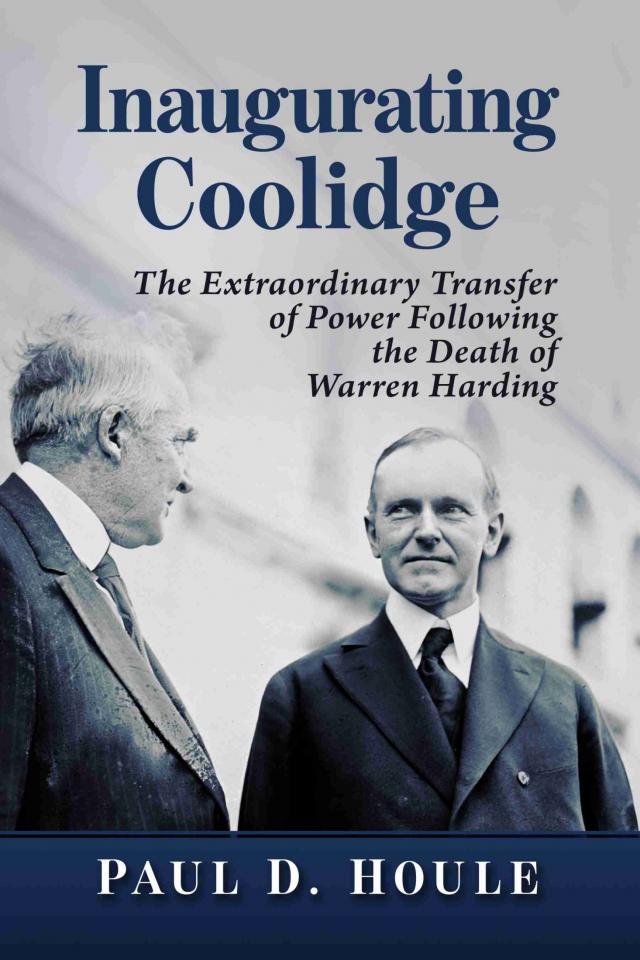


Inaugurating Coolidge
Also by Paul D. Houle and from McFarland
The Crash of Delta Flight 723: The Worst Air Disaster in New England History (2022)
The Crash of Piedmont Airlines Flight 22: Completing the Record of the 1967 Midair Collision Near Hendersonville, North Carolina (2016)
Inaugurating Coolidge
The Extraordinary Transfer of Power Following the Death of Warren Harding
Paul D. Houle
McFarland & Company, Inc., Publishers
Jefferson, North Carolina
ISBN (print) 978-1-4766-9873-1
ISBN (ebook) 979-8-3686-0005-5
Library of Congress cataloging data are available
Library of Congress Control Number 2026009127
© 2026 Paul D. Houle. All rights reserved
No part of this book may be reproduced or transmitted in any form or by any means, electronic or mechanical, including photocopying or recording, or by any information storage and retrieval system, without permission in writing from the publisher.
Front cover image: Warren G. Harding, left, and Calvin Coolidge, 1920 (Library of Congress).
Printed in the United States of America
McFarland & Company, Inc., Publishers
Box 611, Jefferson, North Carolina 28640
www.mcfarlandpub.com
To my wife Shari and son Alex, who both put enough time, travel, and love into this book to make it theirs as much as mine.
Q. “What are the President’s chances?”
—Herbert Hoover, Secretary of Commerce
A. “Not one in ten.”
—Dr. Raymond Wilbur, July 30, 1923
“There is but one President.”
—Calvin Coolidge, Vice President of the United States
August 1, 1923
“I, Calvin Coolidge, do solemnly swear….”
—Calvin Coolidge, President of the United States
August 3, 1923
Table of Contents
Acknowledgments
Preface
Introduction
Chapter 1
“Something is going to happen to our boss”
Chapter 2
“I don’t like certain symptoms”
Chapter 3
“Are rooms ready at Palace Hotel?”
Chapter 4
“I will not be carried off this train!”
Chapter 5
“Hoover’s tentacles reached far beyond”
Chapter 6
“Sicker than the world ever knew”
Chapter 7
“A violent attack of ptomaine poisoning”
Chapter 8
“Necessary for him to have complete rest”
Chapter 9
“Could lay down 16 of the 22 Republican votes”
Chapter 10
“Harding’s dying”
Chapter 11
“President rested poorly last night”
Chapter 12
“An impassable barrier to the inquisitive”
Chapter 13
“You must be a good soldier”
Chapter 14
“There is no right to strike against the public safety”
Chapter 15
World Court
Chapter 16
“I am distressed at the illness of President Harding”
Chapter 17
“Situation has changed to one of hopefulness”
Chapter 18
Succession Act of 1886
Chapter 19
“Sorely felt the need of a president”
Chapter 20
“Get the doctors, quick!”
Chapter 21
“Something of the gravest nature had occurred”
Chapter 22
“Do you want him to do it?”
Chapter 23
“I do, so help me God!”
Chapter 24
“You’ve got your story, Joe”
Bibliography
Index of Terms
Acknowledgments
The author would like to thank the following individuals and organizations for their help with this project: The Calvin Coolidge Foundation; Sherry Hall, manager of the Harding Presidential Sites in Marion, Ohio; Craig Wright, archivist at the Herbert Hoover Presidential Library and Museum; Chris Belena, archives technician at the Franklin D. Roosevelt Presidential Library and Museum; Peggy Dillard, librarian and archivist at the Woodrow Wilson Presidential Library and Museum; and Lloyd Neal, assistant librarian at the Southeastern Railway Museum and the Research Services Department of the Boston Public Library. I would also like to thank Chris Petzy of Seacoast Vacation Rentals for coordinating my stay at the Bridgewater Inn (formerly the Furman House) on the hundredth anniversary of the Coolidge inaugural, as well as my hosts for my research trips to New England, John and Penny Maliska.
Preface
One of the proudest hallmarks of our democracy is the constitutional directive to hold presidential elections every four years. If a new president is elected, a peaceful transition occurs from one administration to the next. If voters decide to reelect the current president, a tranquil continuation of the current administration remains in effect until the next election four years hence.
But what happens when a president dies, resigns, or is removed from office before their term expires? Until 1967, the Constitution wrapped the process in a vague shawl with no firm answer as to who would succeed to the vacant office. Article II, Section 1 of the Constitution reads, “In Case of the Removal of the President from Office, or of his Death, Resignation, or Inability to discharge the Powers and Duties of the said Office, the Same shall devolve on the Vice President.” When the first test of this clause erupted in April 1841 with the death of President William Henry Harrison, many in Congress interpreted this section to read that the vice president would only assume the “Powers and Duties of the said Office,” not the presidential office itself. In other words, the vice president would become an “acting president.” Harrison’s vice president John Tyler took a different view—he assumed the powers and duties of the office as well as the office itself. He became the president, but only after taking the presidential oath of office. This act, known as the Tyler Precedent, guided the actions of all subsequent vice presidents who assumed the presidential office due to death, resignation, or disability. However, this action by Tyler only created a precedent; it was not law. Precedents are easily overturned. Finally, to allay any confusion regarding the matter, the United States, in 1967, ratified the 25th Amendment to the Constitution, which clarified the matter of presidential succession: “In case of the removal of the President from office or of his death or resignation, the Vice President shall become President.” This eliminated the Tyler Precedent and supplanted it with law.
The sudden removal of a president, whether by death, incapacitation, or resignation, can create great trauma among the citizenry. During this time of great upheaval, the people crave one thing: continuity. Before assuming the presidency, vice presidents generally follow the same unwritten routine. They, or some high-ranking administration official, acknowledge the president’s death and perhaps say a few kind words about them. Next, the vice president takes the presidential oath of office and assumes the presidency. Once done, unless they are already there, the vice president returns to Washington, D.C., to rule as president. After these ceremonial rites are completed, the country generally slides into acceptance of the former president’s death and the accession of the successor.
This book analyzes one of the least studied, yet most dramatic, presidential transitions in history: the August 3, 1923, inauguration of Calvin Coolidge. President Warren G. Harding, elected in 1920 by a huge margin, had embarked on a cross-continental railroad and ship tour on June 20, 1923. This trip took him as far north as Fairbanks, Alaska. Upon his return through Canada and the northwestern states, he fell desperately ill. After almost a week of treatment, he died in San Francisco, California, on Thursday evening, August 2, 1923.
During that pivotal week, secretary of commerce and future president Herbert Hoover assumed the role of assistant president by making executive decisions, writing and releasing major policy speeches, and attending meetings with government officials on behalf of President Harding.
Before he left on his long journey, Harding had appointed his secretary of state, Charles Evans Hughes, who remained in Washington, D.C., to act in his stead should an emergency arise. He also extended to Hughes the extraordinary power of calling a cabinet meeting without Harding’s attendance. Hughes boasted an incredible political background. He had been the governor of New York, a justice of the United States Supreme Court, and the 1916 Republican candidate for president. Like Hoover, he too assumed the role of an assistant president. Never before or since had the executive branch of government seen such a power-sharing arrangement. Nor had the executive branch been so geographically separated.
During this dramatic week, Vice President Calvin Coolidge vacationed in his boyhood home in Plymouth, Vermont. The house had no phone and no electricity. Except for a phone located at the village store across the street, manned only during the day, Coolidge was virtually isolated from the rest of the country except through messages brought to him from others. Through these messages, and newspap er reports, he followed Harding’s illness and commented via the newspaper reporters who had gathered in Plymouth at the news of Harding’s sickness. Coolidge remained in the worst place for him to assume the presidency if something fatal happened to Harding. No federal official resided anywhere near Plymouth to administer the oath should the situation arise. Getting the news to Coolidge at night if Harding died would create a confusing logistical issue, as most phone and telegraph offices were closed in the evenings. But he could not leave Plymouth. If he had done so and proceeded to Washington, it would have fueled speculation that he had gone there to assume power before the president died. No vice president could ever afford to have that notoriety attached to their name. By staying in Plymouth, Coolidge ran the risk of being unaware of Harding’s death for many hours after the event. What decisions would Hoover or Hughes make if Harding died and Coolidge could not be reached? Could they legally make those decisions? Would they?
These are the questions dealt with in this book. From a detailed analysis of notes left by the primary political and medical actors in this drama, as well as autobiographies and biographies of those actors and a comprehensive study of newspaper and magazine articles during this time, I explain the actions of Hoover and Hughes. Most importantly, I also explain the actions of Calvin Coolidge, who not only had to unite the country around him, but also had to take immediate action to consolidate a divided executive branch under his power as well as eradicate any actual or perceived power that Hoover or Hughes would still want to exercise on behalf of the president.
Introduction
My fascination with presidential history dates back to my elementary school days, when I memorized the list of names of the men who had occupied the office. Once my teachers at John R. Briggs Elementary School in Ashburnham, Massachusetts, found out I knew the names of the 37 presidents (at that time) by heart, they asked me to recite them in front of my class on many occasions. As each presidential election passed, I added a new name to the list. Even today, I exercise my memory by reciting the names every morning.
I believe eras of history are defined by the people who rule during them. Some eras are remembered fondly, others not so much, and a lot of that has to do with the president during the time remembered. To understand certain events of American history, one must understand the man who occupied the presidential office during that time.
Most presidents come to office through election by the American people. Others become president through the death or resignation of the previous president. In our history, eight men have assumed the presidency through death and one through resignation. Of the eight, four succeeded murdered presidents and four succeeded the office through illness.
Many books have been written about the abrupt succession of those vice presidents who assumed the office because of an assassination. Only a few have been written about those who have assumed the office through illness, as death from illness lacks the drama and horror of a presidential assassination.
In 1923, Vice President Calvin Coolidge assumed the office of president of the United States. His predecessor, President Warren Harding, had suffered from cardiac and respiratory issues for more than a week. Just prior to his death, he seemed to have recovered from the illness, but then he suddenly died from a heart attack or stroke, depending on which doctor you believe. How Harding died is not relevant; the fact that he did die is entirely relevant. His death unleashed the presidency of Calvin Coolidge, who during his five years in office presided over one of the most prosperous decades in American history, known to all as the Roaring Twenties.
Many books have been written about Calvin Coolidge. With most biographies of famous men, authors struggle to cover their subject’s entire life in a limited number of pages, hence many important events are discussed only briefly. I have found this to be the case with Calvin Coolidge’s life, even from Coolidge himself in his Autobiography.
The most dramatic and extraordinary event in Coolidge’s life, indeed in presidential history, took place on the night of August 2–3, 1923, at his childhood home in Plymouth Notch, Vermont. There, just after midnight, Coolidge received a telegram notifying him that President Harding had died. What unfolded during the next several hours of that early August morning can only be described as one of the most remarkable presidential transitions in history.
There has been no comprehensive study written on this inaugural. Several pamphlets, as well as a few pages of faded memories, have been published by members of the small group of witnesses who observed the ceremony in the parlor of the Coolidge Homestead. A small book by Vrest Orton, titled Calvin Coolidge’s Unique Vermont Inauguration, aptly described the Coolidge swearing in, but with limited sources and a well-intentioned tendency to wrap the event in Green Mountain lore, Orton’s book falls short on the motives that propelled Coolidge to take the oath so quickly. The legend of Coolidge being sworn in by his father in the shadows of a kerosene lamp in his childhood home deserves a unique place in American legend, but the truth is far more complex.
Calvin Coolidge took the oath of office early that morning because he possessed a coldly calculating political mind, and he sensed that if he did not grasp the presidency quickly, others would exercise presidential powers without the constitutional authority to do so.
A comprehensive study of Coolidge’s abrupt transition to the presidency cannot be adequately covered unless the story of Harding’s illness is paired with it. The actions of Harding’s cabinet and staff during the president’s illness, particularly those of Secretary of Commerce Herbert Hoover and Secretary of State Charles Evans Hughes, weighed greatly on Coolidge’s decision to take the oath so quickly.
While Coolidge’s policies as president may be debated by historians for generations to come, his actions on that predawn summer morning in 1923 set in motion an inauguration that should be considered one of the most consequential and dramatic, yet least studied, inaugurations in American history.
Chapter 1
“Something is going to happen to our boss”
The oppressive heat caught a jumpstart on the sun as the presidential train approached Roseburg, Oregon, on Saturday morning, July 28, 1923. This rolling White House had been on the tracks since June 20, 1923, when President Warren G. Harding left Union Station in Washington, D.C., and began his cross-country “Voyage of Understanding” to Alaska. The entire presidential party, excluding the Secret Service, consisted of 34 individuals who had a political or personal relationship with the president. They included three cabinet secretaries and their aides as well as Harding’s military aides, stenographers, messengers, a nurse, a maid, and the Speaker of the House of Representatives. The number of press representatives almost exactly matched the number of those in the presidential party.1
They had endured a five-week journey from the East, through the broiling Midwest, the arid dryness of the Southwest, and the dampness of the Pacific Northwest. From there, most journeyed with the president on the military ship transport USS Henderson for a three-week tour of Alaska, penetrating almost as far north as the Arctic Circle. The party was to return to the United States through Canada. The rest of the scheduled trip included a run down the Pacific railroads through Oregon and California to San Diego where, on August 4, they would again board the Henderson and sail home to Washington through the Panama Canal. The cross-country train journey, then the boat voyage to Alaska, would have withered the strength of an Olympic athlete, and Harding gamely fought off his fatigue. But on Friday night, July 27, the unremitting heat, the brutal schedule, and the political troubles that awaited Harding upon his return home crushed his spirit. He collapsed in his compartment onboard the presidential railcar Superb and his personal doctor confined him to bed.2






